
Hi everyone,
Welcome to another Mathsbaron lesson.
In the previous lessons, we learned about fractions and decimals. We also learned how to multiply and divide them.
In this lesson, we will learn about percentages.
Percentages are used everywhere: in exam marks, discounts, profit and loss, interest, sports scores, surveys and many real-life situations.
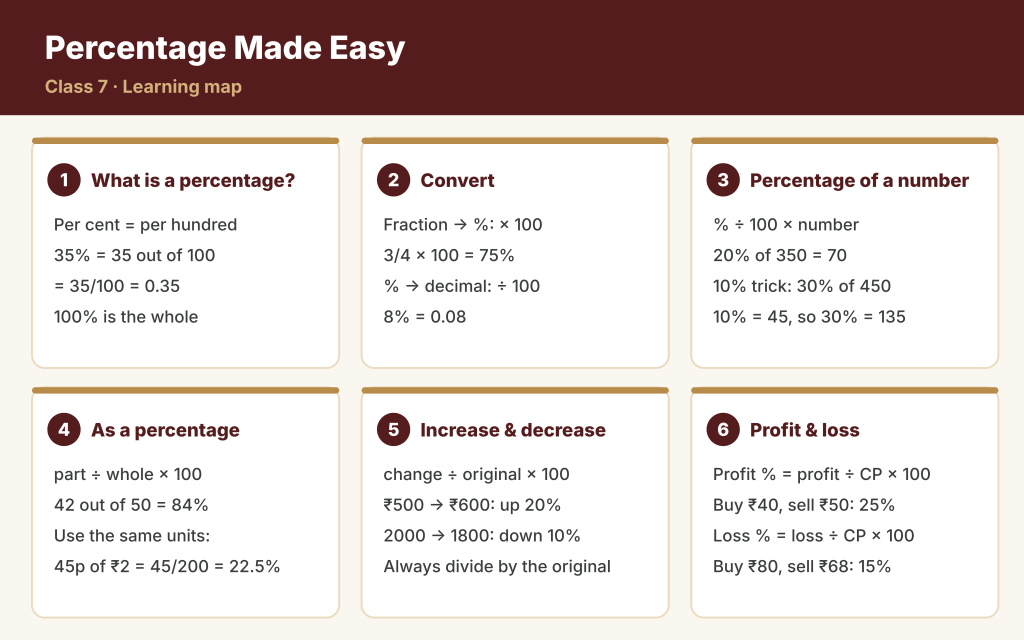
Let us understand percentages step by step.
What Is a Percentage?
The word percentage means per hundred. The symbol for percentage is %.
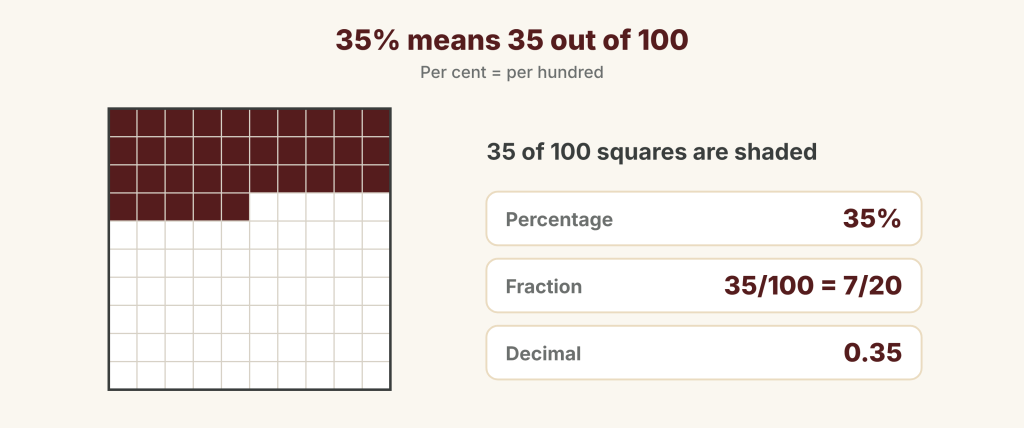
So, when we say 25%, it means 25 out of 100.
In fraction form: 25% = 25/100
In decimal form: 25% = 0.25
So, percentage is another way of writing a fraction or decimal with denominator 100. Picture a grid of 100 squares: the percentage tells you how many of them are shaded.
Simple Examples
50% means 50 out of 100.
50% = 50/100 = 1/2
So, 50% means half.
25% means 25 out of 100.
25% = 25/100 = 1/4
So, 25% means one-fourth.
75% means 75 out of 100.
75% = 75/100 = 3/4
So, 75% means three-fourths.
A percentage can also be more than 100%. 100% is the whole, so 150% means one and a half times the whole.
Why Percentages Are Useful
Percentages make comparison easy.
For example, suppose two students scored marks in different tests.
Student A scored 45 out of 50.
Student B scored 72 out of 100.
At first, it may look difficult to compare because the total marks are different. But if we convert both into percentages:
Student A: 45/50 × 100 = 90%
Student B: 72/100 × 100 = 72%
Now we can compare easily. Student A scored a higher percentage.
Percentage, Fraction and Decimal Connection
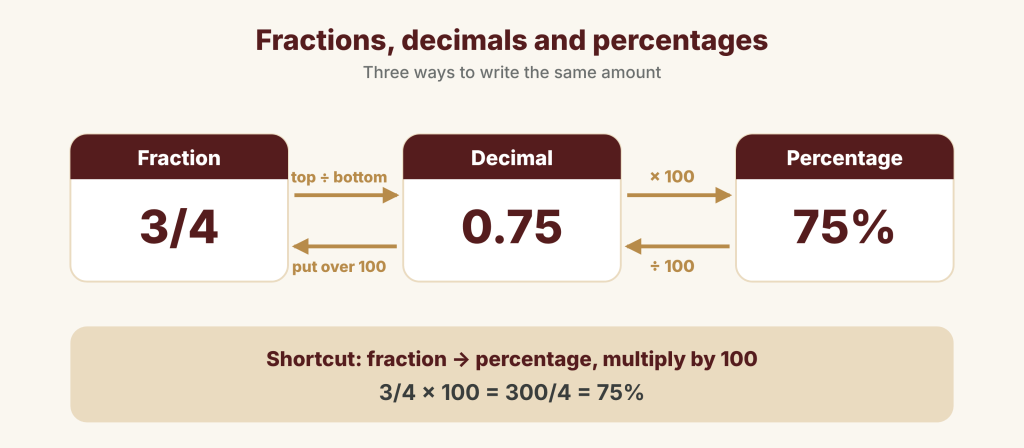
Percentages, fractions and decimals are connected. They are three ways of writing the same amount.
| Percentage | Fraction | Decimal |
|---|---|---|
| 50% | 1/2 | 0.5 |
| 25% | 1/4 | 0.25 |
| 75% | 3/4 | 0.75 |
| 10% | 1/10 | 0.1 |
| 20% | 1/5 | 0.2 |
| 100% | 1 | 1.0 |
These values are useful to remember.
Converting Percentage to Fraction
To convert a percentage into a fraction, write it over 100 and simplify.
Example: 40%
Write it as 40/100
Simplify: 40/100 = 2/5
So, 40% = 2/5
Another example: 75%
Write it as 75/100
Simplify: 75/100 = 3/4
So, 75% = 3/4
Converting Percentage to Decimal
To convert a percentage into a decimal, divide by 100.
Example: 35% = 35 ÷ 100 = 0.35
Another example: 8% = 8 ÷ 100 = 0.08
Remember: when converting percentage to decimal, move the decimal point two places to the left.
Converting Fraction to Percentage
To convert a fraction into a percentage, multiply by 100.
Example: 1/2 × 100 = 50, so 1/2 = 50%
Another example: 3/4 × 100 = 75, so 3/4 = 75%
Converting Decimal to Percentage
To convert a decimal into a percentage, multiply by 100.
Example: 0.6 × 100 = 60, so 0.6 = 60%
Another example: 0.25 × 100 = 25, so 0.25 = 25%
Remember: when converting decimal to percentage, move the decimal point two places to the right.
Finding Percentage of a Number
To find a percentage of a number, convert the percentage into a fraction or decimal and multiply.
Example: Find 20% of 50.
20% = 20/100 = 1/5
Now: 1/5 × 50 = 10
So, 20% of 50 = 10
Example 1: Find 10% of a Number
Find 10% of 80.
10% = 10/100 = 1/10
So: 1/10 × 80 = 8
Therefore, 10% of 80 = 8
Example 2: Find 25% of a Number
Find 25% of 200.
25% = 25/100 = 1/4
So: 1/4 × 200 = 50
Therefore, 25% of 200 = 50
Example 3: Find 50% of a Number
Find 50% of 90.
50% = 1/2
So: 1/2 × 90 = 45
Therefore, 50% of 90 = 45
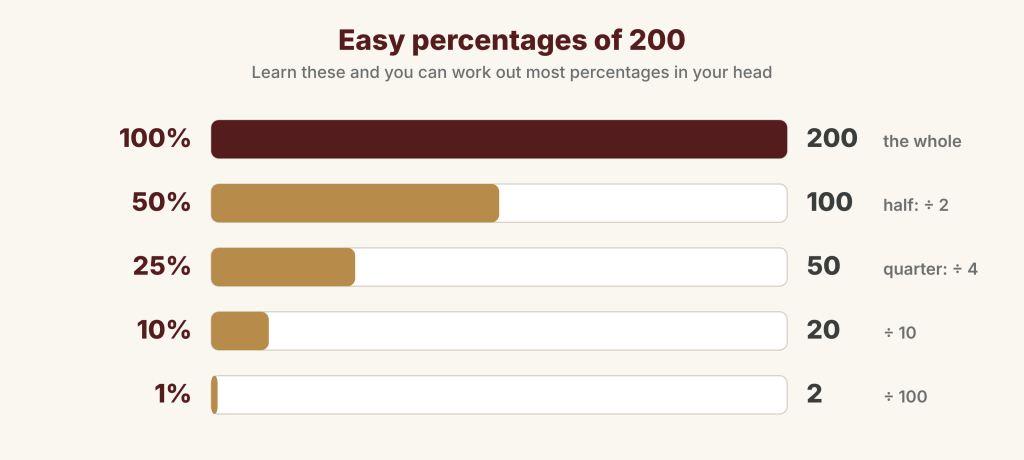
These easy percentages are worth knowing by heart:
The 10% Trick
Once you know 10% of a number, you can build almost any other percentage in your head. To find 10%, just divide by 10.
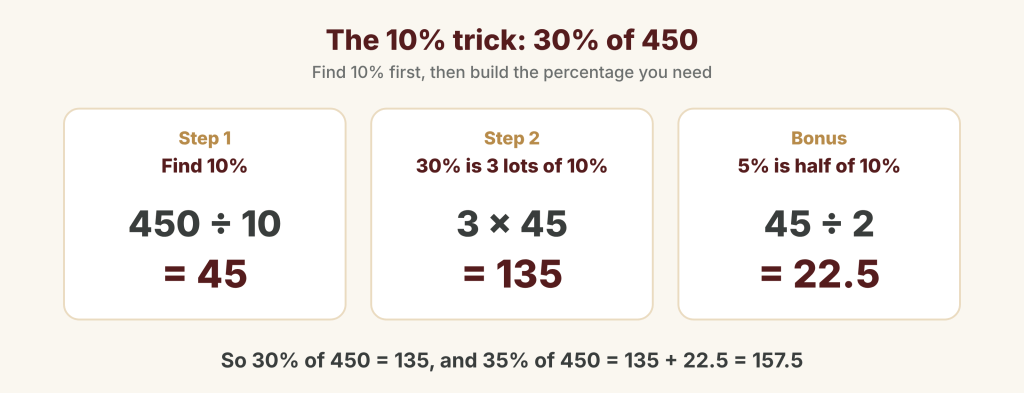
Example: Find 15% of 80.
10% of 80 = 8
5% of 80 = half of 8 = 4
So, 15% of 80 = 8 + 4 = 12
Percentage in Marks
Percentages are commonly used in exam marks.
Formula: Percentage = Marks obtained ÷ Total marks × 100
Example: A student scored 72 marks out of 80.
Percentage = 72/80 × 100
First simplify: 72/80 = 9/10
Now: 9/10 × 100 = 90
So, 72 out of 80 = 90%
The same formula works for any quantity: part ÷ whole × 100.
Use the same units
Both quantities must be in the same unit before you divide.
Example: What percentage of ₹2 is 45 paise?
First change ₹2 into paise: ₹2 = 200 paise.
45/200 × 100 = 22.5%
Finding the Whole When the Percentage Is Known
Sometimes we know a part and its percentage, and need to find the whole. The easiest way is to find 1% first.
Example: 25% of a number is 40. What is the number?
25% = 40
1% = 40 ÷ 25 = 1.6
100% = 1.6 × 100 = 160
Check: 25% of 160 = 160 ÷ 4 = 40. ✓
Percentage in Discounts
Percentages are also used in discounts.
Example: A bag costs ₹1000. The shop gives a discount of 20%. Find the discount amount.
20% of 1000 = 20/100 × 1000 = 200
So, the discount is ₹200.
New price: ₹1000 − ₹200 = ₹800
So, after the discount, the bag costs ₹800.
Percentage Increase
Percentage increase is used when a value goes up. We always compare the increase with the original value.
Percentage increase = Increase ÷ Original value × 100
Example: The price of a book increased from ₹80 to ₹100.
Increase: ₹100 − ₹80 = ₹20
Percentage increase: 20/80 × 100 = 25%
So, the price increased by 25%. Notice that we divide by 80, the original price, not by 100, the new price.
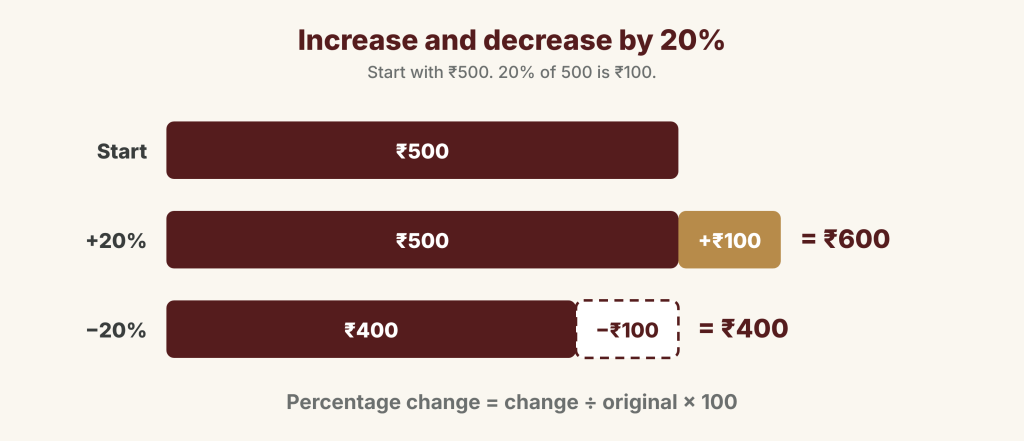
Percentage Decrease
Percentage decrease is used when a value goes down.
Percentage decrease = Decrease ÷ Original value × 100
Example: The price of a toy decreased from ₹500 to ₹400.
Decrease: ₹500 − ₹400 = ₹100
Percentage decrease: 100/500 × 100 = 20%
So, the price decreased by 20%.
Profit and Loss Percentage
Shopkeepers use percentages every day. The cost price (CP) is what the shopkeeper pays for an item. The selling price (SP) is what the customer pays.
- If SP is more than CP, there is a profit: Profit = SP − CP
- If SP is less than CP, there is a loss: Loss = CP − SP
Profit and loss percentages are always worked out on the cost price:
Profit % = Profit ÷ CP × 100
Loss % = Loss ÷ CP × 100
Example 1: A pen is bought for ₹40 and sold for ₹50.
Profit = ₹50 − ₹40 = ₹10
Profit % = 10/40 × 100 = 25%
Example 2: A toy is bought for ₹80 and sold for ₹68.
Loss = ₹80 − ₹68 = ₹12
Loss % = 12/80 × 100 = 15%
Percentages in Daily Life
We use percentages in many daily situations:
- exam marks
- shopping discounts
- bank interest
- profit and loss
- attendance
- sports statistics
- mobile battery percentage
- survey results
- population data
This is why percentage is an important topic in Class 7 mathematics.
Common Mistakes Students Make
Here are some common mistakes to avoid.
Mistake 1: Forgetting That Percentage Means Out of 100
Wrong thinking: 30% means 30
Correct thinking: 30% means 30 out of 100
So, 30% = 30/100 = 0.3
Mistake 2: Moving the Decimal Point in the Wrong Direction
To convert a percentage to a decimal, move two places to the left: 45% = 0.45
To convert a decimal to a percentage, move two places to the right: 0.45 = 45%
Mistake 3: Dividing by the Wrong Number in Percentage Increase
If a price increases from ₹400 to ₹460, the increase is ₹60, not ₹460.
Percentage increase is the increase divided by the original value:
60/400 × 100 = 15%
Do not divide by the new value (460), and do not divide by 100 just because it is a percentage.
Mistake 4: Mixing Units
45 paise as a percentage of ₹2 is 45/200 × 100 = 22.5%, not 45/2 × 100. Change both quantities to the same unit first.
Mistake 5: Thinking an Increase and a Decrease Cancel Out
₹100 increased by 10% is ₹110. Now decrease ₹110 by 10%: 10% of 110 is 11, so we get ₹99, not ₹100. The second 10% is taken from a bigger amount.
Mistake 6: Thinking a Percentage Can Never Be More Than 100%
If you had ₹200 and now have ₹500, you have 250% of what you started with. Percentages above 100% are perfectly normal.
Quick Practice
Try solving these questions.
- Write 25% as a fraction.
- Write 75% as a decimal.
- Convert 1/5 into a percentage.
- Convert 0.4 into a percentage.
- Find 10% of 250.
- Find 20% of 80.
- Find 25% of 120.
- A student scored 45 out of 50. Find the percentage.
- A shirt costs ₹800. The discount is 10%. Find the discount amount.
- A value increases from 200 to 250. Find the percentage increase.
- Use the 10% trick to find 15% of 240.
- What percentage of ₹3 is 75 paise?
- 20% of a number is 45. Find the number.
- A shopkeeper buys a toy for ₹250 and sells it for ₹300. Find the profit percentage.
Answers
Show answers
- 1/4
- 0.75
- 20%
- 40%
- 25
- 16
- 30
- 90%
- ₹80
- 25% (50/200 × 100)
- 36 (10% = 24, 5% = 12)
- 25% (75/300 × 100)
- 225 (1% = 45 ÷ 20 = 2.25)
- 20% (profit ₹50, and 50/250 × 100)
Final Thoughts
Percentage is a simple and useful topic once we understand that it means out of 100.
Percentages are connected to fractions and decimals:
50% = 1/2 = 0.5
25% = 1/4 = 0.25
75% = 3/4 = 0.75
Once you understand these connections, percentages become much easier.
Start with simple values like 10%, 25%, 50% and 75%. Then move to more complex problems involving marks, discounts, increase and decrease, and profit and loss. And remember: for increase, decrease, profit and loss, always divide by the original value.
With regular practice, percentages will become one of the most useful and interesting topics in mathematics.
Next lesson: Ready for more? Learn how to compare quantities and share in a ratio in Ratio and Proportion Made Easy for Class 7.
Happy learning,
Mathsbaron


Leave a Reply