
Hi everyone,
Welcome to another Mathsbaron lesson.
In the previous lessons, we learned about fractions, decimals and percentages. These topics help us compare parts of a whole.
In this lesson, we will learn about ratio and proportion.
Ratio and proportion are very useful in mathematics and real life. We use them in recipes, maps, speed, sharing money, comparing quantities and solving word problems.
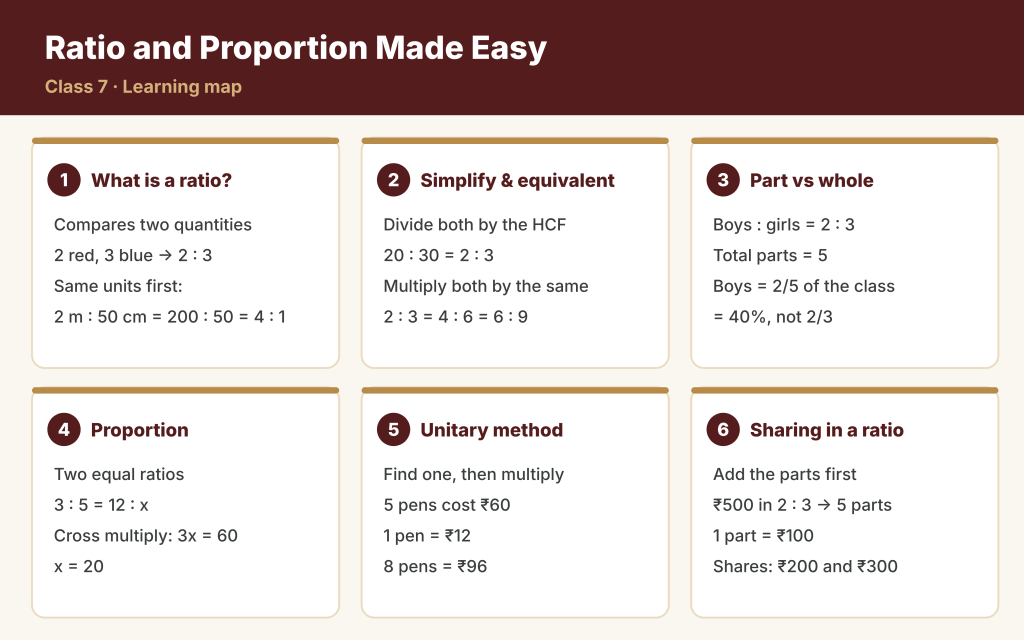
Let us understand them step by step.
What Is a Ratio?
A ratio is used to compare two quantities.
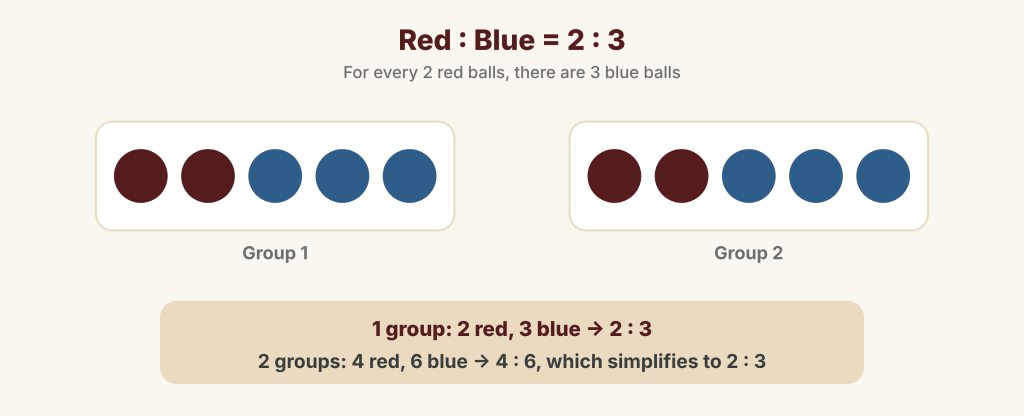
For example, suppose there are 2 red balls and 3 blue balls. The ratio of red balls to blue balls is 2 : 3.
This is read as 2 is to 3. It means for every 2 red balls, there are 3 blue balls.
Ratio as a Fraction
A ratio can also be written as a fraction: 2 : 3 = 2/3. So, ratios and fractions are closely connected.
Example: The ratio of boys to girls in a class is 12 : 18.
This can be written as 12/18.
Now simplify: 12/18 = 2/3
So, 12 : 18 = 2 : 3
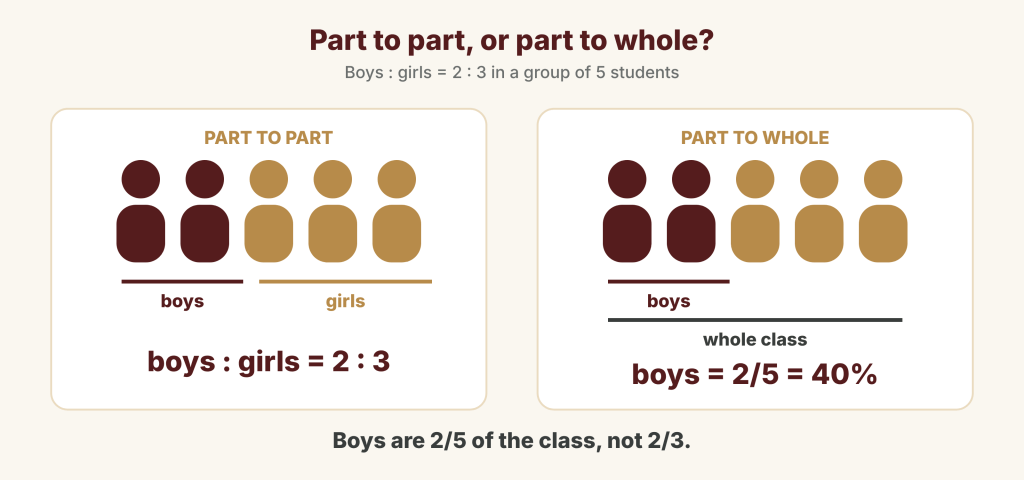
Be careful: part to part, or part to whole?
If boys : girls = 2 : 3, then for every 2 boys there are 3 girls. That makes 2 + 3 = 5 students in each group.
So, boys are 2/5 of the class, not 2/3.
2 : 3 compares boys with girls. 2/5 compares boys with the whole class.
Simplifying Ratios
A ratio should usually be written in its simplest form. To simplify a ratio, divide both numbers by their highest common factor (HCF).
Example: Simplify 20 : 30.
The highest common factor of 20 and 30 is 10.
20 ÷ 10 = 2 and 30 ÷ 10 = 3
So, 20 : 30 = 2 : 3
Example 1: Simplifying a Ratio
Simplify 15 : 25.
The highest common factor of 15 and 25 is 5.
15 ÷ 5 = 3 and 25 ÷ 5 = 5
So, 15 : 25 = 3 : 5
Example 2: Simplifying a Ratio
Simplify 18 : 24.
The highest common factor of 18 and 24 is 6.
18 ÷ 6 = 3 and 24 ÷ 6 = 4
So, 18 : 24 = 3 : 4
Equivalent Ratios
Just like equivalent fractions, we can make equivalent ratios by multiplying or dividing both numbers by the same number.
2 : 3 = 4 : 6 (multiply both by 2)
2 : 3 = 6 : 9 (multiply both by 3)
2 : 3 = 10 : 15 (multiply both by 5)
All of these ratios are equal. They all mean “for every 2, there are 3”.
Important Point About Ratios
Ratios compare quantities of the same type, for example:
- boys and girls
- red balls and blue balls
- rupees and rupees
- kilometres and kilometres
If units are different, convert them into the same unit first.
Example: Find the ratio of 2 metres to 50 centimetres.
First convert 2 metres into centimetres: 2 metres = 200 centimetres
Now the ratio is 200 : 50
Simplify: 200 : 50 = 4 : 1
So, 2 metres : 50 centimetres = 4 : 1
What Is Proportion?
A proportion tells us that two ratios are equal.
Example: 2 : 3 = 4 : 6
This is a proportion because both ratios are equal: 2/3 = 4/6, and 4/6 simplifies to 2/3.
So, 2 : 3 and 4 : 6 are in proportion.
How To Check If Ratios Are in Proportion
To check whether two ratios are in proportion, convert them into fractions and compare.
Example: Are 3 : 5 and 6 : 10 in proportion?
Write them as fractions: 3/5 and 6/10
Simplify: 6/10 = 3/5
So, 3 : 5 = 6 : 10. Therefore, they are in proportion.
Cross Multiplication Method
We can also check proportion using cross multiplication.
If a : b = c : d, then a × d = b × c
Example: Check whether 2 : 5 and 6 : 15 are in proportion.
Cross multiply: 2 × 15 = 30 and 5 × 6 = 30
Both are equal. So, 2 : 5 = 6 : 15. They are in proportion.
Example: Are These Ratios in Proportion?
Check whether 4 : 7 and 8 : 14 are in proportion.
Cross multiply: 4 × 14 = 56 and 7 × 8 = 56
Both are equal. So, 4 : 7 and 8 : 14 are in proportion.
Finding a Missing Number in Proportion
Sometimes, one number is missing.
Example: 3 : 5 = 12 : x. We need to find x.
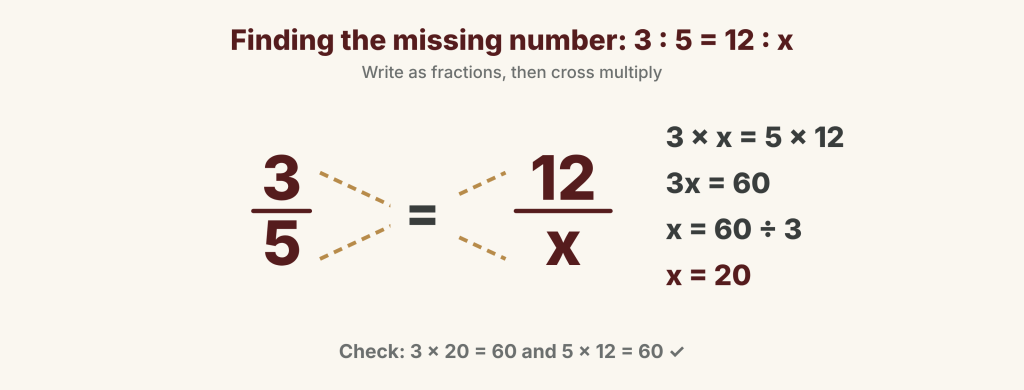
Using cross multiplication:
3 × x = 5 × 12
3x = 60
x = 60 ÷ 3
x = 20
So, 3 : 5 = 12 : 20
Another Example
Find x: 4 : 9 = x : 27
Using cross multiplication:
4 × 27 = 9 × x
108 = 9x
x = 108 ÷ 9
x = 12
So, 4 : 9 = 12 : 27
The Unitary Method
In the unitary method, we first find the value of one unit, then multiply.
Example: 5 pens cost ₹60. What do 8 pens cost?
Cost of 1 pen = ₹60 ÷ 5 = ₹12
Cost of 8 pens = 8 × ₹12 = ₹96
Another example: A car travels 150 km on 10 litres of petrol. How far can it travel on 4 litres?
On 1 litre: 150 ÷ 10 = 15 km
On 4 litres: 4 × 15 = 60 km
Ratio in Real Life
Ratios are used in many real-life situations.
Example 1: Recipe
A lemonade recipe uses sugar and lemon juice in the ratio 2 : 5.
This means for every 2 spoons of sugar, we use 5 spoons of lemon juice. If we use 4 spoons of sugar, then lemon juice should become 10 spoons.
So, 2 : 5 = 4 : 10
Example 2: Sharing Money
Two friends share ₹500 in the ratio 2 : 3.
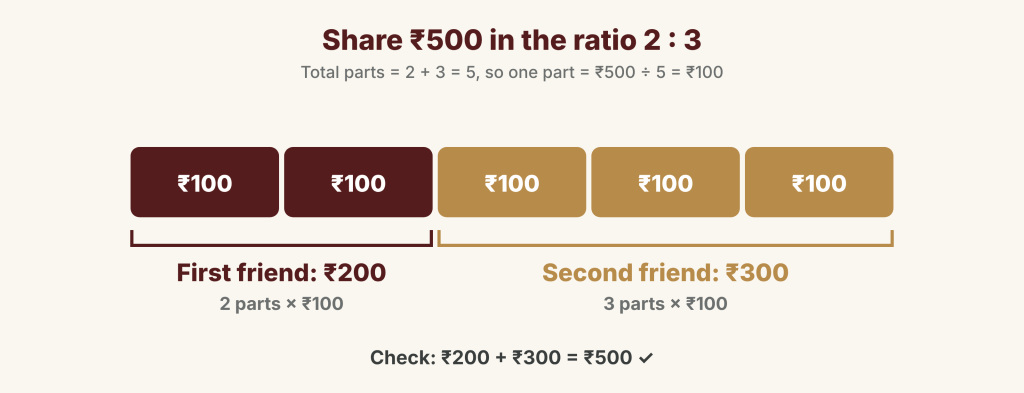
Total parts: 2 + 3 = 5
Value of one part: ₹500 ÷ 5 = ₹100
First friend gets: 2 × ₹100 = ₹200
Second friend gets: 3 × ₹100 = ₹300
So, the money is shared as ₹200 and ₹300.
The same method works for more than two people. Share ₹900 among three friends in the ratio 2 : 3 : 4.
Total parts: 2 + 3 + 4 = 9
One part: ₹900 ÷ 9 = ₹100
Shares: ₹200, ₹300 and ₹400
Example 3: Map Scale
If a map uses the scale 1 cm : 10 km, it means 1 cm on the map represents 10 km in real life.
So, 5 cm on the map represents 5 × 10 = 50 km.
Notice that the units here are different, so this is really a scale. Written as a true ratio in the same unit, it is 1 : 10,00,000, because 10 km = 10,00,000 cm.
Ratio, Fraction and Percentage Connection
Ratios, fractions and percentages are connected.
Example: The ratio of boys to girls in a class is 2 : 3.
Total parts: 2 + 3 = 5
So, boys are 2/5 of the class.
Convert into percentage: 2/5 × 100 = 40%
So, if boys : girls = 2 : 3, then boys make up 40% of the class, and girls make up 3/5 = 60%.
This is why learning fractions and percentages helps us understand ratio better.
Common Mistakes Students Make
Here are some common mistakes to avoid.
Mistake 1: Not Using the Same Units
Wrong: 2 metres : 50 centimetres = 2 : 50
Correct: First convert 2 metres into centimetres. 2 metres = 200 centimetres.
So, 200 : 50 = 4 : 1
Mistake 2: Not Simplifying the Ratio
12 : 18 should be simplified: 12 : 18 = 2 : 3.
Always write the ratio in simplest form unless the question says otherwise.
Mistake 3: Reversing the Order
The ratio of boys to girls is not the same as girls to boys.
If boys : girls = 3 : 4, then girls : boys = 4 : 3.
Order matters.
Mistake 4: Confusing Ratio With Difference
Ratio compares by division, not subtraction.
If there are 6 red balls and 3 blue balls, the ratio is 6 : 3 = 2 : 1.
The difference is 6 − 3 = 3.
Ratio and difference are not the same.
Mistake 5: Confusing Part to Part With Part to Whole
If boys : girls = 2 : 3, boys are not 2/3 of the class.
Add the parts first: 2 + 3 = 5. So, boys are 2/5 of the class.
Quick Practice
Try solving these questions.
- Simplify 10 : 15.
- Simplify 24 : 36.
- Write 5 : 8 as a fraction.
- Check whether 2 : 3 and 6 : 9 are in proportion.
- Check whether 4 : 5 and 12 : 20 are in proportion.
- Find x: 3 : 4 = 15 : x.
- Find x: 5 : 6 = x : 30.
- Convert 1 metre : 25 centimetres into its simplest ratio.
- Share ₹600 in the ratio 1 : 2.
- A recipe uses milk and water in the ratio 3 : 2. If milk is 9 cups, how much water is needed?
- Boys : girls in a class = 3 : 5. What fraction of the class are boys?
- 6 notebooks cost ₹90. What do 10 notebooks cost?
- Share ₹720 in the ratio 1 : 2 : 3.
- Write two ratios equivalent to 3 : 4.
Answers
Show answers
- 2 : 3
- 2 : 3
- 5/8
- Yes, they are in proportion.
- No, they are not in proportion.
- x = 20
- x = 25
- 4 : 1
- ₹200 and ₹400
- 6 cups
- 3/8 (3 + 5 = 8 parts)
- ₹150 (1 notebook = ₹15)
- ₹120, ₹240 and ₹360 (1 part = ₹720 ÷ 6 = ₹120)
- For example, 6 : 8 and 9 : 12
Final Thoughts
Ratio and proportion help us compare quantities and understand relationships between numbers.
A ratio compares two quantities. A proportion shows that two ratios are equal.
Remember:
- Simplify ratios whenever possible
- Keep the units the same
- Use cross multiplication to check proportion
- Pay attention to the order of comparison
- Add the parts first when you need a fraction of the whole
- Use the unitary method: find one, then multiply
Once you understand ratio and proportion, many other topics such as percentage, profit and loss, simple interest and speed become easier.
Start with simple examples. Practise slowly. With time, ratio and proportion will become one of the most useful topics in mathematics.
Next lesson: Ready for more? See how percentages work with savings and loans in Simple Interest Made Easy for Class 7.
Happy learning,
Mathsbaron


Leave a Reply