
Hi everyone,
Welcome to another Mathsbaron lesson.
In the previous lessons, we learned about fractions, decimals, percentages, ratio and proportion. These topics help us compare numbers and understand real-life calculations.
In this lesson, we will learn about simple interest.
Simple interest is used in money-related situations such as savings, loans, borrowing and lending. It helps us calculate how much extra money is paid or earned over time.
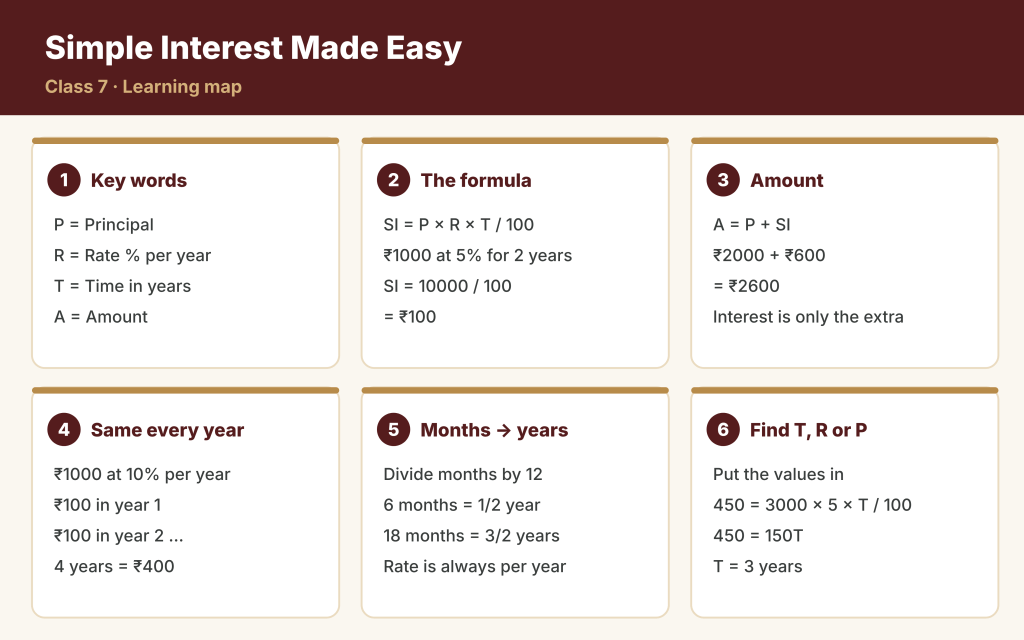
Let us understand it step by step.
What Is Interest?
Interest is the extra money paid or earned for using money over a period of time.
For example, if you borrow money from someone, you may have to return the original money plus some extra amount. That extra amount is called interest.
Similarly, if you deposit money in a bank, the bank may give you some extra money after a period of time. That extra money is also called interest.
What Is Simple Interest?
Simple interest is interest calculated only on the original amount of money. The original amount is called the principal.
In simple interest, the interest does not get added again and again for calculating future interest. So, the interest is the same every year.
Example: ₹1000 is deposited at 10% per year.
Interest for 1 year = 10% of ₹1000 = ₹100
| Year | Interest for the Year | Total Interest | Amount |
|---|---|---|---|
| 1 | ₹100 | ₹100 | ₹1100 |
| 2 | ₹100 | ₹200 | ₹1200 |
| 3 | ₹100 | ₹300 | ₹1300 |
| 4 | ₹100 | ₹400 | ₹1400 |
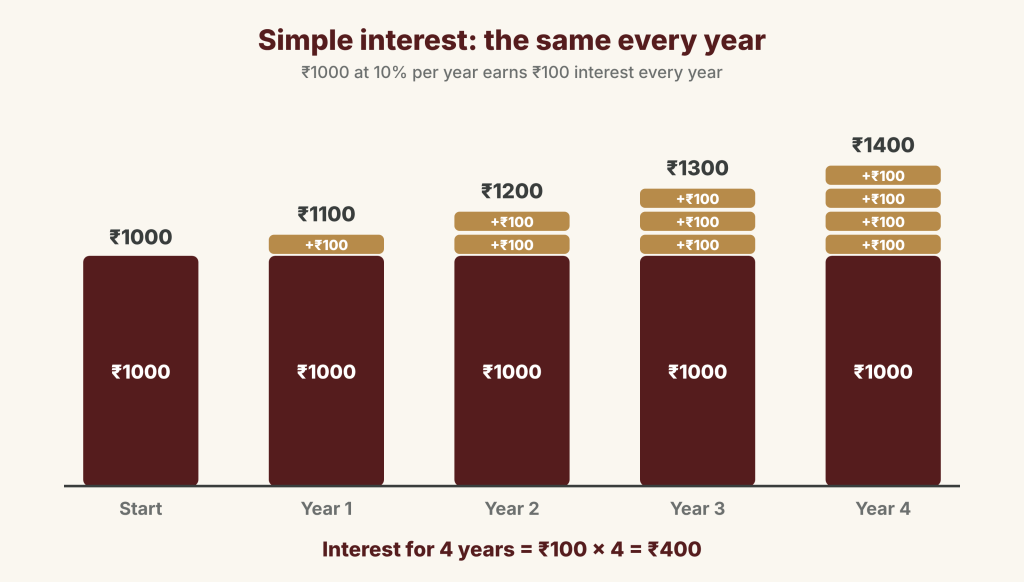
Notice that the interest is ₹100 every year. It does not grow. That is why it is called simple interest.
Important Terms
Before learning the formula, let us understand a few important terms.
Principal
The money borrowed, lent or deposited is called the principal. It is usually written as P.
Example: If you deposit ₹5000 in a bank, then Principal = ₹5000.
Rate of Interest
The rate of interest tells us how much interest is charged or earned for every ₹100 in one year. It is written as R.
Example: If the rate is 5% per year, it means ₹5 interest is earned on every ₹100 in one year.
You will often see the words per annum. Per annum simply means per year.
Time
Time is the period for which money is borrowed, lent or deposited. It is usually written as T.
Time is generally given in years, for example 2 years, 3 years or 5 years. If it is given in months, we change it into years (we will see how below).
Simple Interest Formula
The formula for simple interest is:
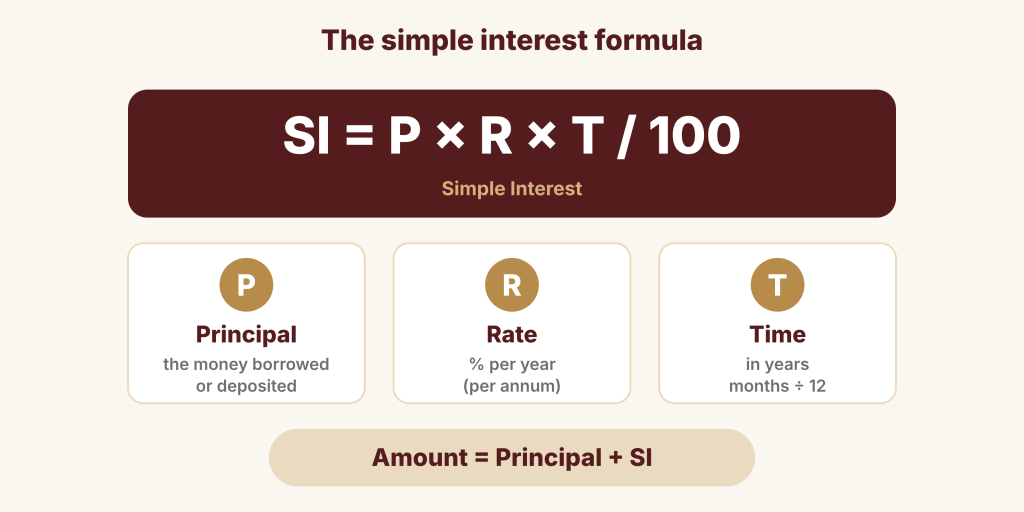
Simple Interest = Principal × Rate × Time / 100
In short: SI = P × R × T / 100
- SI = Simple Interest
- P = Principal
- R = Rate of interest per year
- T = Time in years
Example 1: Finding Simple Interest
Find the simple interest on ₹1000 at 5% per year for 2 years.
Here: P = 1000, R = 5, T = 2
Use the formula:
SI = P × R × T / 100
SI = 1000 × 5 × 2 / 100
SI = 10000 / 100
SI = 100
So, the simple interest is ₹100.
What Is Amount?
Amount is the total money after adding simple interest to the principal.
Formula: Amount = Principal + Simple Interest
In short: A = P + SI
In the previous example:
Principal = ₹1000
Simple Interest = ₹100
So, Amount = 1000 + 100 = ₹1100
The person will receive or pay ₹1100 after 2 years.
Example 2: Finding Simple Interest and Amount
Find the simple interest and amount on ₹2000 at 10% per year for 3 years.
Here: P = 2000, R = 10, T = 3
Use the formula:
SI = P × R × T / 100
SI = 2000 × 10 × 3 / 100
SI = 60000 / 100
SI = 600
So, Simple Interest = ₹600
Now find the amount:
Amount = Principal + Simple Interest
Amount = 2000 + 600
Amount = ₹2600
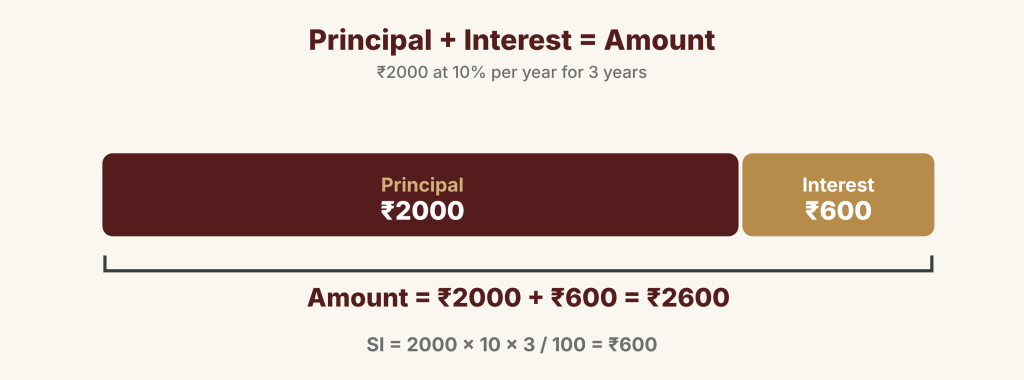
So, the amount after 3 years is ₹2600.
When Time Is Given in Months
The rate is always per year, so time must also be in years. If time is given in months, divide by 12.
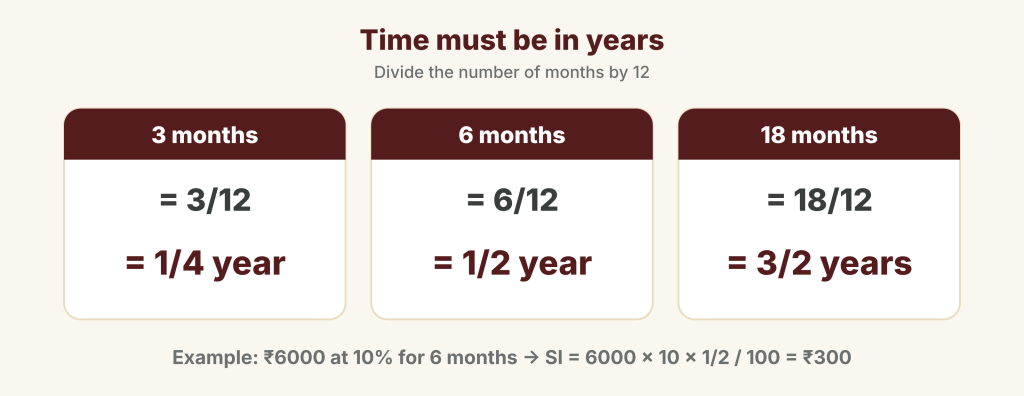
Example: Find the simple interest on ₹6000 at 10% per year for 6 months.
T = 6 months = 6/12 = 1/2 year
SI = 6000 × 10 × 1/2 / 100
SI = 30000 / 100
SI = ₹300
Example 3: Finding Time
Sometimes, we may need to find time.
Example: Find the time if the simple interest on ₹3000 at 5% per year is ₹450.
We know: SI = 450, P = 3000, R = 5, T = ?
Use the formula: SI = P × R × T / 100
Substitute the values:
450 = 3000 × 5 × T / 100
450 = 15000T / 100
450 = 150T
Now divide:
T = 450 ÷ 150
T = 3
So, the time is 3 years.
Example 4: Finding Rate
Find the rate of interest if the simple interest on ₹4000 for 2 years is ₹800.
We know: SI = 800, P = 4000, T = 2, R = ?
Use the formula: SI = P × R × T / 100
Substitute the values:
800 = 4000 × R × 2 / 100
800 = 8000R / 100
800 = 80R
Now divide:
R = 800 ÷ 80
R = 10
So, the rate of interest is 10% per year.
Example 5: Finding Principal
Find the principal if the simple interest is ₹600, rate is 5% per year and time is 4 years.
We know: SI = 600, R = 5, T = 4, P = ?
Use the formula: SI = P × R × T / 100
Substitute the values:
600 = P × 5 × 4 / 100
600 = 20P / 100
600 = P / 5
So:
P = 600 × 5
P = 3000
The principal is ₹3000.
Example 6: When the Amount Is Given
₹8000 becomes ₹9200 in 3 years at simple interest. Find the rate.
First find the interest:
SI = Amount − Principal
SI = 9200 − 8000 = ₹1200
Now substitute the values:
1200 = 8000 × R × 3 / 100
1200 = 24000R / 100
1200 = 240R
R = 1200 ÷ 240
R = 5
So, the rate is 5% per year.
Remember: always find the interest first. Do not put the amount into the formula.
Simple Interest in Real Life
Simple interest is used in many real-life situations, such as money deposited in a bank, money borrowed from a friend, loans and savings schemes. Let us solve a few.
Example 1: Savings in a Bank
Meera deposits ₹15,000 in a bank at 6% per year for 4 years.
SI = 15000 × 6 × 4 / 100 = ₹3600
Amount = ₹15,000 + ₹3600 = ₹18,600
So, Meera gets back ₹18,600 after 4 years.
Example 2: Loan for a Bicycle
Aman borrows ₹12,000 to buy a bicycle at 9% per year for 2 years.
SI = 12000 × 9 × 2 / 100 = ₹2160
Total amount to repay = ₹12,000 + ₹2160 = ₹14,160
So, the bicycle actually costs Aman ₹2160 more because of the loan.
Example 3: Choosing the Better Deposit
Which gives more interest on ₹5000?
Option A: 6% per year for 3 years
Option B: 8% per year for 2 years
Option A: SI = 5000 × 6 × 3 / 100 = ₹900
Option B: SI = 5000 × 8 × 2 / 100 = ₹800
So, Option A gives more interest, even though its rate is lower. Time matters too.
Understanding simple interest helps students connect mathematics with everyday money decisions.
Difference Between Principal, Interest and Amount
| Term | Meaning |
|---|---|
| Principal | Original money |
| Interest | Extra money paid or earned |
| Amount | Principal plus interest |
Example: If principal is ₹5000 and interest is ₹500, then Amount = ₹5000 + ₹500 = ₹5500.
Simple Interest and Percentage Connection
Simple interest is just percentage applied again and again. The rate R% tells us what percentage of the principal is added as interest each year.
Example: ₹2000 at 10% per year
10% of ₹2000 = ₹200 every year
In 5 years: ₹200 × 5 = ₹1000
In 10 years, the interest is ₹200 × 10 = ₹2000, which is equal to the principal. So, ₹2000 doubles to ₹4000 in 10 years at 10% per year.
Common Mistakes Students Make
Here are some common mistakes to avoid.
Mistake 1: Forgetting To Divide by 100
Wrong: SI = P × R × T
Correct: SI = P × R × T / 100
Since rate is given in percentage, we must divide by 100.
Mistake 2: Confusing Simple Interest and Amount
Simple interest is only the extra money. Amount is the total money.
Amount = Principal + Simple Interest
Mistake 3: Using Months Directly as Years
Time should be in years. If time is given in months, convert it into years.
Wrong: SI on ₹6000 at 10% for 6 months = 6000 × 10 × 6 / 100 = ₹3600
Correct: 6 months = 1/2 year, so SI = 6000 × 10 × 1/2 / 100 = ₹300
Mistake 4: Putting the Amount Into the Formula
When the amount is given, subtract the principal first to find the interest.
₹8000 becomes ₹9200. The interest is ₹1200, not ₹9200.
Mistake 5: Thinking the Interest Grows Every Year
In simple interest, the interest is the same every year. ₹1000 at 10% earns ₹100 in the first year, ₹100 in the second year and ₹100 in every year after that.
Quick Practice
Try solving these questions.
- Find the simple interest on ₹1000 at 6% per year for 2 years.
- Find the simple interest on ₹5000 at 5% per year for 3 years.
- Find the amount if principal is ₹2000 and simple interest is ₹300.
- Find the amount on ₹4000 at 10% per year for 2 years.
- Find the simple interest on ₹2500 at 8% per year for 1 year.
- Find the time if SI = ₹600, P = ₹3000, R = 10%.
- Find the rate if SI = ₹400, P = ₹2000, T = 4 years.
- Find the principal if SI = ₹500, R = 5%, T = 2 years.
- Convert 6 months into years.
- Find the simple interest on ₹1200 at 5% per year for 6 months.
- ₹6000 becomes ₹7200 in 2 years at simple interest. Find the rate.
- Ravi borrows ₹8000 at 12% per year for 18 months. How much must he repay?
- Which gives more interest on ₹5000: 6% per year for 3 years, or 8% per year for 2 years?
- At what rate will ₹2000 double itself in 10 years?
Answers
Show answers
- ₹120
- ₹750
- ₹2300
- ₹4800
- ₹200
- 2 years
- 5%
- ₹5000
- 1/2 year
- ₹30
- 10% (SI = ₹1200, so 1200 = 6000 × R × 2 / 100 = 120R)
- ₹9440 (18 months = 3/2 years, SI = ₹1440)
- 6% for 3 years (₹900 compared with ₹800)
- 10% (to double, SI = ₹2000, so 2000 = 2000 × R × 10 / 100 = 200R)
Final Thoughts
Simple interest is an important topic because it connects mathematics with money.
Remember the formula: SI = P × R × T / 100
Also remember: Amount = Principal + Simple Interest
- Time must be in years, so divide months by 12
- When the amount is given, find the interest first
- In simple interest, the interest is the same every year
Once you understand principal, rate and time, simple interest problems become much easier.
Start with direct formula-based questions. Then practise finding amount, time, rate and principal.
Later, in higher classes, you will learn about compound interest, where interest is also added on the interest. Simple interest is the first step.
With regular practice, simple interest will become a simple and useful topic.
Happy learning,
Mathsbaron


Leave a Reply