
Hi everyone,
Welcome to another Mathsbaron lesson for Class 7 Mathematics. In this lesson, we will learn about Fractions and Decimals.
Fractions and decimals are everywhere: in measurement, money, time, percentages, ratios and data handling. They are also two ways of writing the same idea, a part of a whole. Once you see how they connect, both become much easier.
Let us begin step by step.
What Is a Fraction?
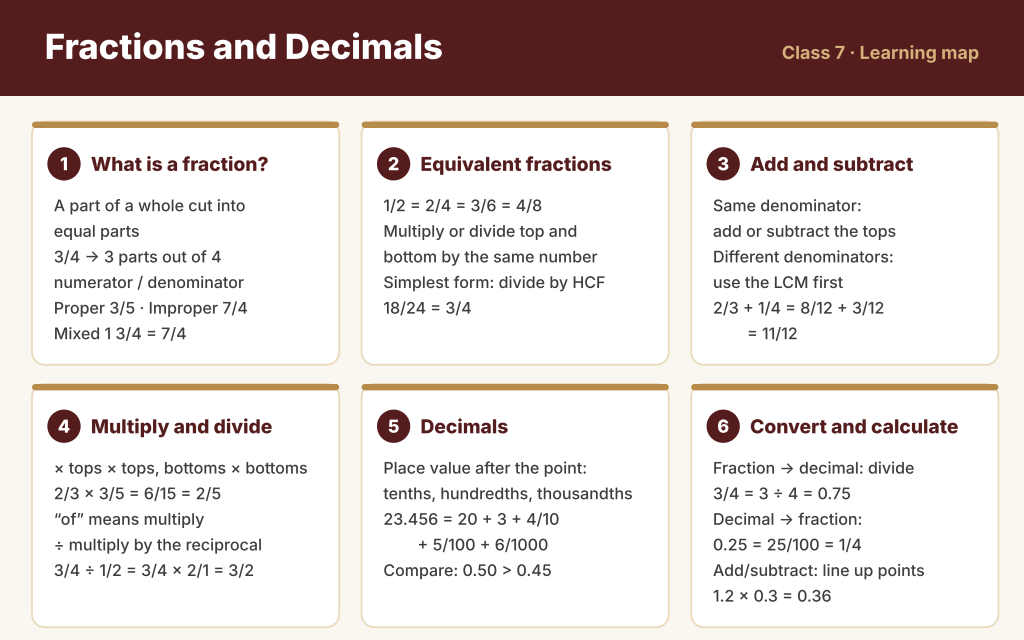
A fraction represents a part of a whole that has been divided into equal parts.
Suppose a pizza is cut into 4 equal slices and you eat 1 slice. You have eaten 1/4 of the pizza, read as “one-fourth”.
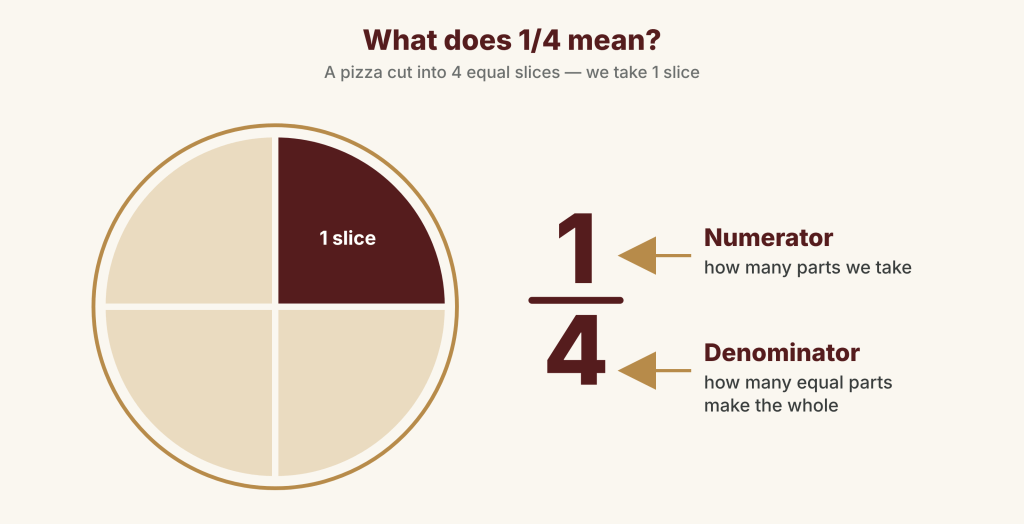
- The bottom number, 4, is the denominator. It tells us how many equal parts the whole is divided into.
- The top number, 1, is the numerator. It tells us how many of those parts we are taking.
So 3/4 means three out of four equal parts, and 5/8 means five out of eight equal parts. We use fractions all the time: half a glass of water, three-fourths of a chocolate bar, one-third of a cake.
Types of Fractions
1. Proper fractions
The numerator is smaller than the denominator, so the value is less than 1.
Examples: 1/2, 3/5, 7/10
2. Improper fractions
The numerator is greater than or equal to the denominator, so the value is 1 or more.
Examples: 5/3, 7/4, 9/9
3. Mixed fractions
A whole number and a proper fraction written together.
Examples: 1 1/2, 2 3/4, 5 2/3
Changing between mixed and improper fractions
Mixed → improper: multiply the whole number by the denominator, add the numerator, and keep the same denominator.
2 3/4 = (2 × 4 + 3)/4 = 11/4
Improper → mixed: divide the numerator by the denominator. The quotient is the whole number and the remainder is the new numerator.
17/5: 17 ÷ 5 = 3 remainder 2, so 17/5 = 3 2/5
Equivalent Fractions
Equivalent fractions look different but have the same value.
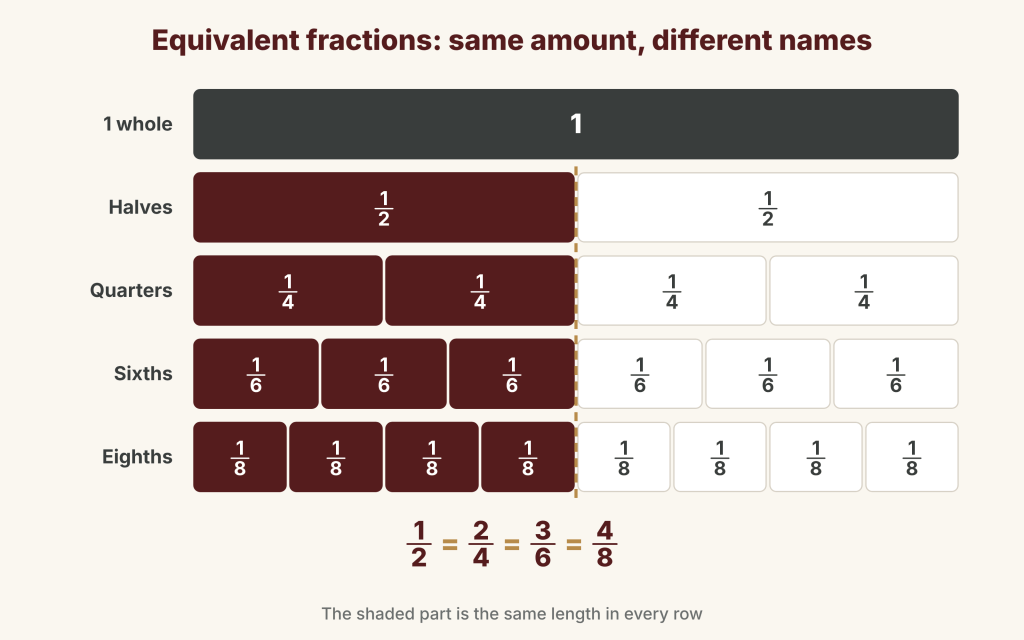
We make an equivalent fraction by multiplying or dividing the numerator and denominator by the same number. For example, 1/2 = (1 × 3)/(2 × 3) = 3/6. Multiplying top and bottom by the same number is the same as multiplying by 1, so the value does not change.
Simplest form
A fraction is in its simplest form when the numerator and denominator have no common factor other than 1. To simplify, divide both by their HCF (highest common factor).
18/24: the HCF of 18 and 24 is 6, so 18/24 = (18 ÷ 6)/(24 ÷ 6) = 3/4.
Comparing Fractions
Same denominator: the fraction with the larger numerator is greater. 3/7 > 2/7, because 3 parts out of 7 is more than 2 parts out of 7.
Different denominators: rewrite both fractions with a common denominator, usually the LCM (lowest common multiple) of the denominators, then compare the numerators.
Compare 2/3 and 3/5. The LCM of 3 and 5 is 15.
2/3 = 10/15 and 3/5 = 9/15
Since 10 > 9, we get 2/3 > 3/5.
Adding and Subtracting Fractions
Same denominator
Add or subtract the numerators and keep the denominator.
2/7 + 3/7 = 5/7
5/8 − 2/8 = 3/8
Different denominators
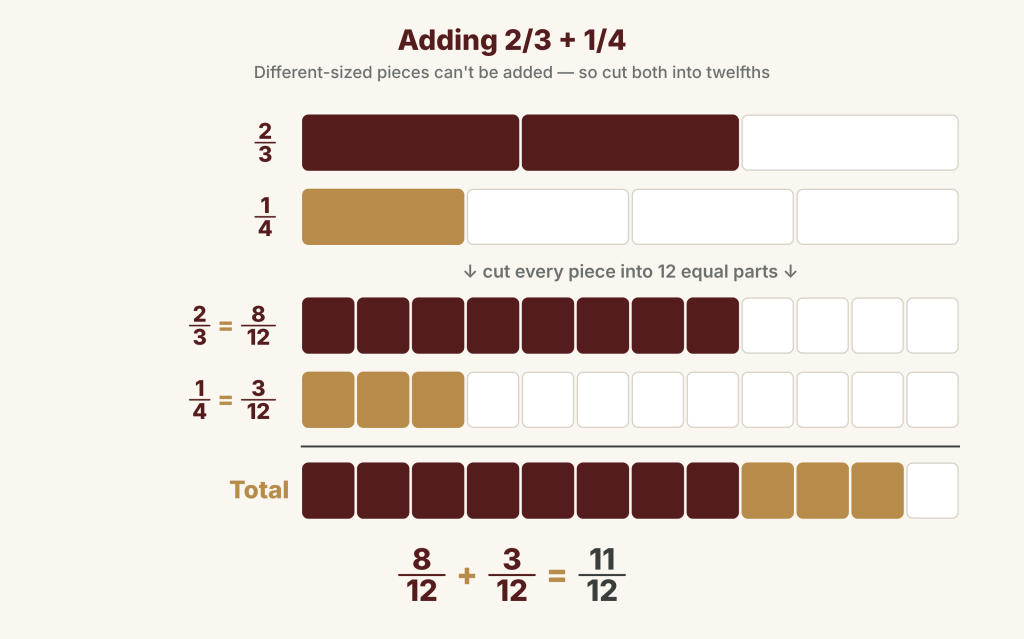
First rewrite the fractions with a common denominator (the LCM), then add or subtract.
2/3 + 1/4: the LCM of 3 and 4 is 12.
2/3 = 8/12 and 1/4 = 3/12
8/12 + 3/12 = 11/12
5/6 − 1/4: the LCM of 6 and 4 is 12.
5/6 = 10/12 and 1/4 = 3/12
10/12 − 3/12 = 7/12
A common mistake is to add the tops and the bottoms separately: 1/2 + 1/3 is not 2/5. Pieces of different sizes cannot be added until they are cut to the same size.
Mixed fractions
Change them to improper fractions first.
1 1/2 + 2 1/3 = 3/2 + 7/3 = 9/6 + 14/6 = 23/6 = 3 5/6
Multiplying Fractions
Multiply the numerators together and the denominators together, then simplify.
2/3 × 3/5 = (2 × 3)/(3 × 5) = 6/15 = 2/5
“Of” means multiply. So 3/4 of 20 = 3/4 × 20 = 60/4 = 15.
Dividing Fractions
To divide by a fraction, multiply by its reciprocal. The reciprocal of a fraction is found by turning it upside down: the reciprocal of 2/3 is 3/2.
3/4 ÷ 1/2 = 3/4 × 2/1 = 6/4 = 3/2 = 1 1/2
This makes sense: there are one and a half halves in three-quarters.
What Is a Decimal?
A decimal is another way of writing a fraction whose denominator is 10, 100, 1000 and so on. The digits after the decimal point show the parts of a whole.
0.5 = 5/10 = 1/2, so 0.5 means half.
Place value in decimals
In the number 23.456:
| Digit | Place | Value |
|---|---|---|
| 2 | Tens | 20 |
| 3 | Ones | 3 |
| 4 | Tenths | 4/10 |
| 5 | Hundredths | 5/100 |
| 6 | Thousandths | 6/1000 |
So 23.456 = 20 + 3 + 4/10 + 5/100 + 6/1000.
Comparing Decimals
Line up the decimal points and compare digit by digit from the left. Adding zeros at the end helps, because it does not change the value.
Which is greater, 0.5 or 0.45?
Write 0.5 as 0.50. Now compare 0.50 and 0.45: 50 hundredths is more than 45 hundredths, so 0.5 > 0.45.
Don’t be fooled by the number of digits: 0.45 has more digits, but it is the smaller number.
Converting Between Fractions and Decimals
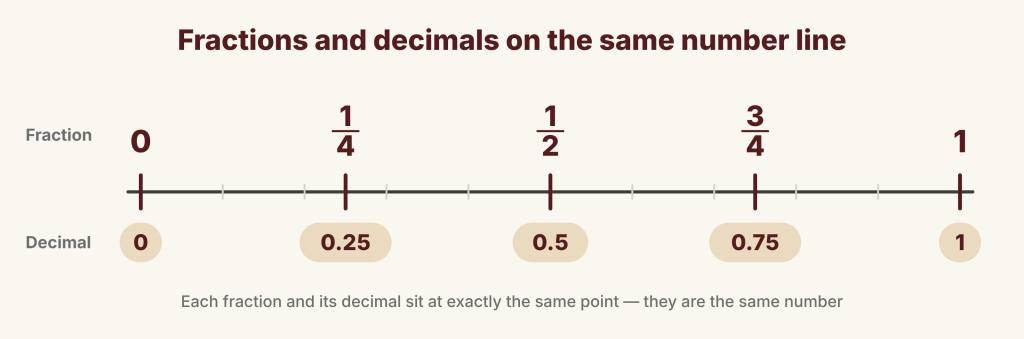
Every fraction has a decimal that sits at exactly the same point on the number line:
Fraction → decimal
Divide the numerator by the denominator.
1/2 = 1 ÷ 2 = 0.5
3/4 = 3 ÷ 4 = 0.75
Some fractions never stop: 1/3 = 0.333… where the 3 repeats forever. These are called recurring decimals.
Decimal → fraction
Count the digits after the decimal point. One digit means the denominator is 10, two digits means 100, three digits means 1000. Then simplify.
0.7 = 7/10
0.25 = 25/100 = 1/4
0.125 = 125/1000 = 1/8
Useful values to remember
| Fraction | Decimal |
|---|---|
| 1/2 | 0.5 |
| 1/4 | 0.25 |
| 3/4 | 0.75 |
| 1/5 | 0.2 |
| 1/8 | 0.125 |
| 1/10 | 0.1 |
| 1/100 | 0.01 |
Adding and Subtracting Decimals
Write the numbers with the decimal points lined up, fill empty places with zeros, then add or subtract as with whole numbers.
2.35 + 1.4 → 2.35 + 1.40 = 3.75
5.6 − 2.35 → 5.60 − 2.35 = 3.25
Multiplying and Dividing Decimals
Multiplying
Multiply as if there were no decimal points. Then count the total number of decimal places in both numbers and put that many in the answer.
1.2 × 0.3: first 12 × 3 = 36. There are 2 decimal places in total (one in 1.2, one in 0.3), so the answer is 0.36.
Dividing by a whole number
Divide as usual and keep the decimal point in the same place.
4.8 ÷ 4 = 1.2
Multiplying and dividing by 10, 100, 1000
Multiplying moves the decimal point right; dividing moves it left, by as many places as there are zeros.
2.5 × 10 = 25
3.6 ÷ 10 = 0.36
0.07 × 100 = 7
Fractions and Decimals in Daily Life
- 1/2 litre of milk, or 0.5 kg of apples
- 3/4 of an hour is 45 minutes
- ₹12.50 means 12 rupees and 50 paise
- A 2.5 km walk, or 0.75 m of cloth
Quick Practice
Try solving these:
- Write 3/5 as a decimal.
- Write 0.25 as a fraction in simplest form.
- Simplify 16/20.
- Write 3 1/2 as an improper fraction.
- 2/5 + 1/3
- 3/4 − 1/6
- 2/3 × 9/10
- 4/5 ÷ 2/3
- Find 2/3 of 24.
- Which is greater: 0.7 or 0.65?
- 2.5 + 1.75
- 6.2 − 3.45
Show answers
- 0.6
- 1/4
- 4/5
- 7/2
- 11/15 (6/15 + 5/15)
- 7/12 (9/12 − 2/12)
- 3/5 (18/30 simplified)
- 1 1/5 (4/5 × 3/2 = 12/10 = 6/5)
- 16
- 0.7 (0.70 > 0.65)
- 4.25
- 2.75
Final Thoughts
Fractions and decimals are two ways of showing the same thing: a part of a whole. A fraction uses a numerator and a denominator; a decimal uses place value and a decimal point.
Remember the key ideas: find a common denominator before adding or subtracting fractions, multiply by the reciprocal to divide, and line up the decimal points when adding or subtracting decimals. Practise with small examples first, and the harder questions will soon feel easy.
Happy learning,
Mathsbaron


Leave a Reply