
Hi everyone,
Welcome to this Mathsbaron lesson for Class 7 Mathematics. In this lesson, we will begin with an important topic: Integers, Powers and Roots.
We often use numbers in daily life without thinking too much about them. We count objects, compare scores, measure temperature, calculate money, and solve problems. But in mathematics, it is important to understand different types of numbers and how they behave.
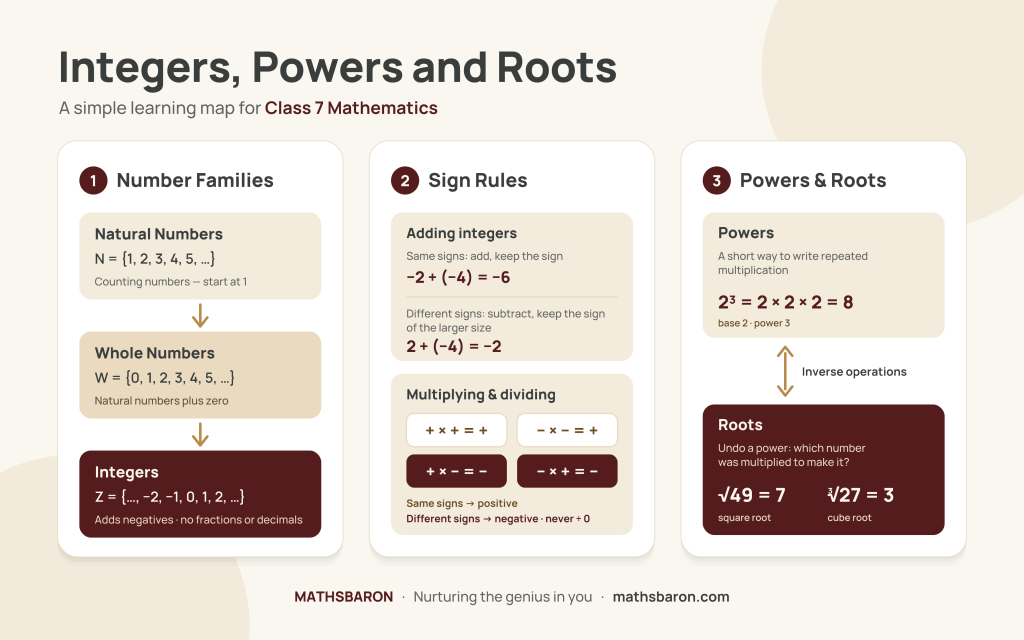
Let us begin step by step.
Natural Numbers
Natural numbers are the counting numbers. They start from 1 and continue without end.
Natural numbers: N = {1, 2, 3, 4, 5, …}
These are the numbers we use when we count things — 1 book, 2 pencils, 3 students, 4 apples.
Whole Numbers
Whole numbers are similar to natural numbers, but they also include zero.
Whole numbers: W = {0, 1, 2, 3, 4, 5, …}
So the main difference is that natural numbers start from 1, while whole numbers start from 0.
What Are Integers?
Integers are the whole numbers together with their negatives. They have no fractions or decimals, and they include:
- Negative numbers
- Zero
- Positive numbers
Integers: ℤ = {…, −4, −3, −2, −1, 0, 1, 2, 3, 4, …}
So numbers like −5, −2, 0, 3 and 10 are integers. But numbers like 1.5, 2/3 and 4.25 are not integers.
Understanding Integers on a Number Line
A number line helps us understand integers clearly. Numbers to the right of zero are positive; numbers to the left of zero are negative.
… −5 −4 −3 −2 −1 0 1 2 3 4 5 …
The further right we move, the greater the number becomes. For example, 5 > 2. Also, −2 > −5, because −2 is closer to zero than −5.
Adding Integers
When we add integers, we need to look carefully at their signs.
1. Same signs
When two numbers have the same sign, add their sizes and keep the same sign.
2 + 4 = 6
−2 + (−4) = −6
So: positive + positive = positive, and negative + negative = negative.
2. Different signs
When two numbers have different signs, subtract the smaller absolute value from the larger absolute value. The answer takes the sign of the number with the larger absolute value.
4 + (−2) = 2 — here 4 has the larger absolute value and is positive, so the answer is positive.
2 + (−4) = −2 — here −4 has the larger absolute value and is negative, so the answer is negative.
Subtracting Integers
Subtraction of integers becomes easier when we remember this rule: to subtract an integer, add its opposite.
5 − 3 = 2
5 − (−3) = 5 + 3 = 8
−4 − 2 = −4 + (−2) = −6
So whenever you see subtraction, try changing it into addition by using the opposite sign.
Multiplying Integers
Multiplication rules are simple once we understand signs.
| Signs | Result | Example |
|---|---|---|
| Positive × Positive | Positive | 3 × 4 = 12 |
| Negative × Negative | Positive | (−3) × (−4) = 12 |
| Positive × Negative | Negative | 3 × (−4) = −12 |
| Negative × Positive | Negative | (−3) × 4 = −12 |
A simple way to remember: same signs give a positive answer; different signs give a negative answer.
Dividing Integers
Division follows the same sign rules as multiplication.
| Signs | Result | Example |
|---|---|---|
| Positive ÷ Positive | Positive | 12 ÷ 3 = 4 |
| Negative ÷ Negative | Positive | (−12) ÷ (−3) = 4 |
| Positive ÷ Negative | Negative | 12 ÷ (−3) = −4 |
| Negative ÷ Positive | Negative | (−12) ÷ 3 = −4 |
Again: same signs give a positive answer; different signs give a negative answer. One more rule to remember: you can never divide by zero — an expression like 7 ÷ 0 has no answer.
What Are Powers?
Powers are a short way of writing repeated multiplication. For example:
2 × 2 × 2 = 2³
This is read as “2 raised to the power 3” or “2 cubed”. Here, 2 is the base and 3 is the power (or exponent). So 2³ = 8.
More examples:
3² = 3 × 3 = 9
4² = 4 × 4 = 16
5³ = 5 × 5 × 5 = 125
Squares and Cubes
When a number is multiplied by itself, the result is its square: 2² = 4, 3² = 9, 4² = 16, 5² = 25.
When a number is used three times in a multiplication, the result is its cube: 2³ = 8, 3³ = 27, 4³ = 64, 5³ = 125.
What Are Roots?
Roots are the opposite of powers. A square root tells us which number was multiplied by itself to get the given number.
√9 = 3, because 3 × 3 = 9.
Other examples: √16 = 4, √25 = 5, √36 = 6.
Similarly, a cube root tells us which number was used three times in a multiplication to get the given number.
∛8 = 2, because 2 × 2 × 2 = 8.
Quick Practice
Try solving these:
- −3 + 7
- −5 + (−6)
- 8 − (−2)
- (−4) × 3
- (−6) × (−2)
- 20 ÷ (−5)
- 3²
- 2³
- √49
- ∛27
Show answers
- 4
- −11
- 10
- −12
- 12
- −4
- 9
- 8
- 7
- 3
Watch the Lesson Video
Watch the video lesson below for more examples of integers and how to work with them.
Final Thoughts
Integers, powers and roots are important building blocks in mathematics. Once you understand number signs, multiplication rules, squares, cubes and roots, many later topics become much easier.
Keep practising with small examples first. Once the basic rules become clear, you will be able to solve more difficult problems with confidence.
Happy learning,
Mathsbaron


Leave a Reply