
Multiplication can feel difficult when students move from single-digit numbers to two-digit and three-digit numbers. In my workshops, the moment a question like 23 × 14 or 123 × 456 appears on the board, faces drop — and the whole class says in unison, “No Ma’am, not again!”
So I teach them a pattern that is easy to remember and lets them write the whole answer in a single line. It is called Vertically and Crosswise.
What is Vertically and Crosswise multiplication?
The method comes from the Vedic Maths sutra Urdhva Tiryagbhyam, which means “vertically and crosswise”. It is one of the sixteen sutras set out by Bharati Krishna Tirtha in his 1965 book Vedic Mathematics. (He said the sutras came from an appendix of the Atharvaveda, but scholars have not found them there — what matters for us is that the method is completely sound.)
In the usual method we multiply one digit at a time, write partial products, shift places and then add. In this method we multiply digits in a fixed pattern:
- First, multiply vertically
- Then, multiply crosswise and add
- Then, multiply vertically again
It works beautifully for two-digit numbers and extends to three digits and beyond.
Example 1: 12 × 34
    1   2
×   3   4
---------
Step 1: Right vertical
Multiply the digits in the ones place: 2 × 4 = 8. Write 8 in the ones place.
Step 2: Crosswise
Multiply each number’s tens digit by the other number’s ones digit, and add: 1 × 4 + 2 × 3 = 4 + 6 = 10. Write 0 and carry 1.
Step 3: Left vertical
Multiply the digits in the tens place: 1 × 3 = 3. Add the carry: 3 + 1 = 4. Write 4.
So, 12 × 34 = 408.
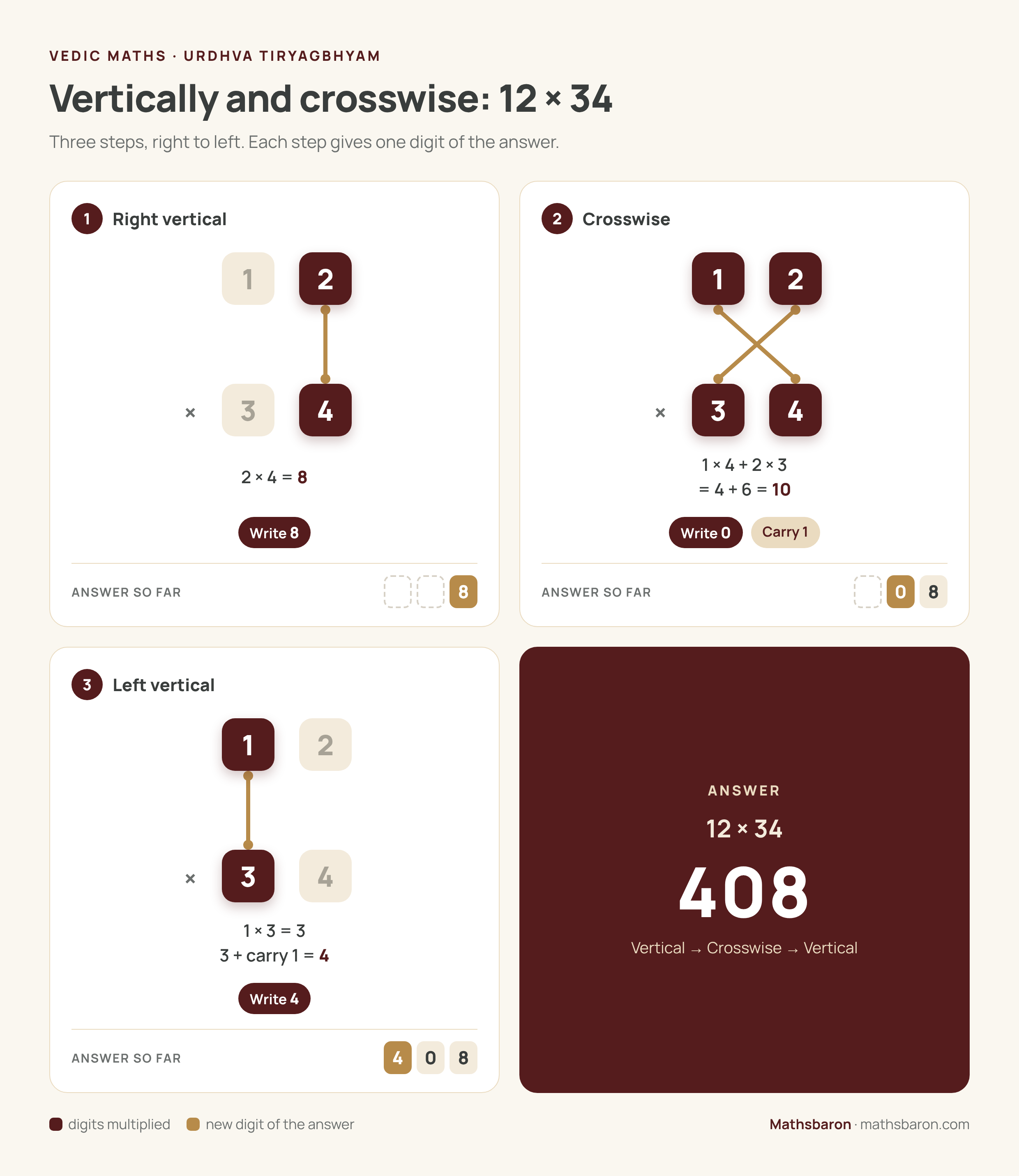
The pattern in one picture
For any two-digit numbers ab × cd:
| Step | Multiply | Gives the |
|---|---|---|
| 1. Right vertical | b × d | ones digit |
| 2. Crosswise | a × d + b × c | tens digit |
| 3. Left vertical | a × c | hundreds (and thousands) |
Remember: Vertical → Crosswise → Vertical. Always work from right to left, and add any carry to the next step.
Why does it work?
A two-digit number ab is really 10a + b. Multiply out the brackets:
(10a + b)(10c + d) = 100(a×c) + 10(a×d + b×c) + (b×d)
The hundreds come from the left vertical, the tens from the crosswise products, and the ones from the right vertical. The method is just place value, organised neatly — there is no magic, which is exactly why it always works.
Example 2: 23 × 14 (with carries)
    2   3
×   1   4
---------
- Right vertical:
3 × 4 = 12→ write 2, carry 1. - Crosswise:
2 × 4 + 3 × 1 = 8 + 3 = 11; add the carry:11 + 1 = 12→ write 2, carry 1. - Left vertical:
2 × 1 = 2; add the carry:2 + 1 = 3→ write 3.
So, 23 × 14 = 322.
Example 3: 123 × 456
    1   2   3
×   4   5   6
-------------
For three-digit numbers the idea is the same, but the pattern has five steps. Each step gives one digit of the answer, from right to left.
| Step | Multiply and add | Total + carry | Write | Carry |
|---|---|---|---|---|
| 1. Right vertical | 3 × 6 | 18 | 8 | 1 |
| 2. Crosswise (right two columns) | 2 × 6 + 3 × 5 = 27 | 27 + 1 = 28 | 8 | 2 |
| 3. Big cross + middle vertical | 1 × 6 + 3 × 4 + 2 × 5 = 28 | 28 + 2 = 30 | 0 | 3 |
| 4. Crosswise (left two columns) | 1 × 5 + 2 × 4 = 13 | 13 + 3 = 16 | 6 | 1 |
| 5. Left vertical | 1 × 4 | 4 + 1 = 5 | 5 | — |
Reading the “Write” column from bottom to top: 123 × 456 = 56,088.
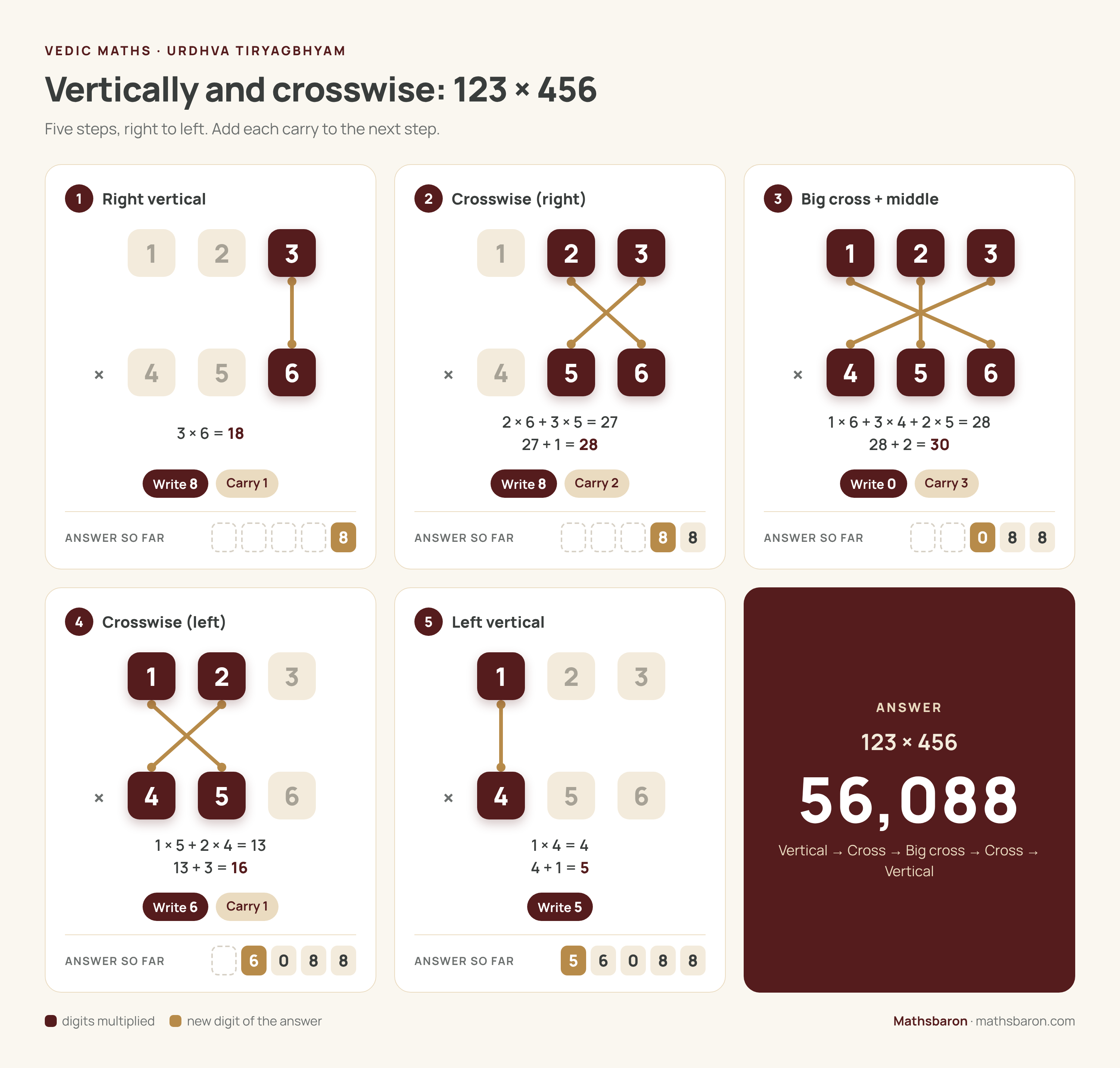
Step 3 is the only new idea: multiply the outer digits crosswise (1 with 6, and 3 with 4), add the middle digits multiplied vertically (2 with 5), then add the carry.
Want more three-digit practice? Try High Speed Mathematics – Multiplication of two three-digit numbers.
Why this method is useful
- The whole answer is written in one line — no partial products to line up.
- It gets faster with practice and works well for mental calculation.
- It strengthens place-value understanding, because every step builds one place of the answer.
- It gives students a simple pattern that is easy to remember.
Students should first be comfortable with their multiplication tables — once the tables are strong, this method becomes much easier. Start with two-digit numbers, practise slowly, then move to three digits.
Practice questions
Solve these using the Vertically and Crosswise method, then check your answers below.
| Two-digit | Three-digit |
|---|---|
1. 21 × 32 | 6. 123 × 234 |
2. 43 × 12 | 7. 214 × 321 |
3. 56 × 24 | 8. 312 × 423 |
4. 78 × 35 | 9. 234 × 312 |
5. 62 × 41 | 10. 111 × 222 |
Show answers
| Two-digit | Three-digit |
|---|---|
| 1. 672 | 6. 28,782 |
| 2. 516 | 7. 68,694 |
| 3. 1,344 | 8. 131,976 |
| 4. 2,730 | 9. 73,008 |
| 5. 2,542 | 10. 24,642 |
Final thoughts
Multiplication becomes easier when students understand the pattern behind the calculation. Vertically and Crosswise may look new at first, but with a little practice the steps become natural — and much more enjoyable.
New to Vedic Maths? Start with Vedic Mathematics – an overview, see the full list of Vedic Mathematics sutras, or try Sutra 1 – Ekadhikena Purvena.
Happy learning,
Mathsbaron


Leave a Reply