
Many students find calculations long, repetitive and sometimes stressful. Multiplication, division, squares and large numbers can look difficult at first. In the workshops I have conducted, I have often seen that calculation is the biggest hurdle between a child and enjoying maths.
Vedic Mathematics offers a different way to look at numbers. Its simple techniques and patterns make calculations faster, easier and more enjoyable — and, more importantly, they help students build confidence.
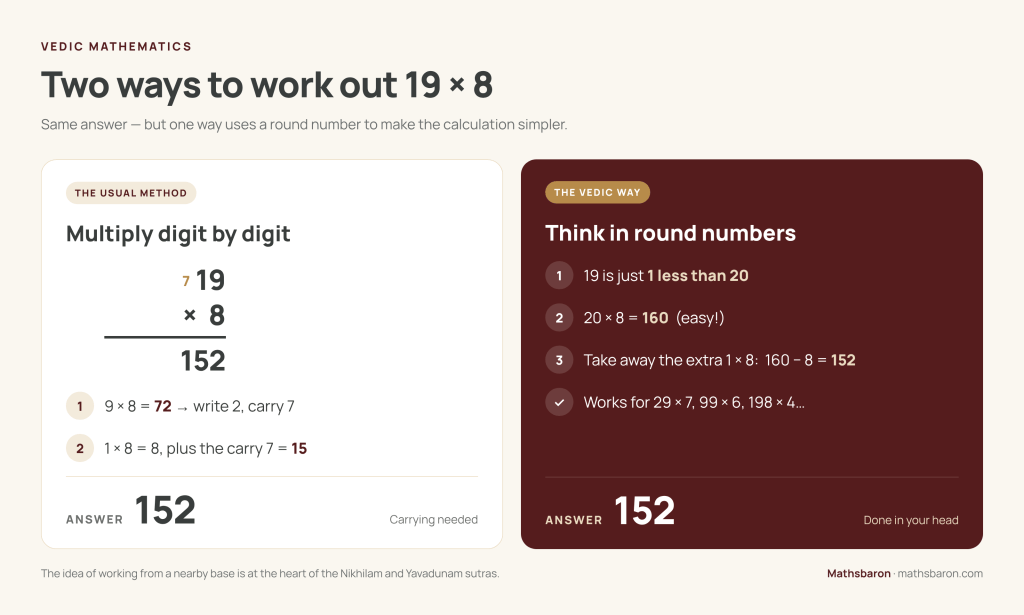
Both methods give 152. The Vedic way simply notices that 19 is close to the round number 20 — and that small shift in thinking is what Vedic Maths is all about.
What is Vedic Mathematics?
Vedic Mathematics is a system of mathematical techniques popularised by Sri Bharati Krishna Tirthaji Maharaj, the Shankaracharya of Puri, in his book Vedic Mathematics, published in 1965. Tirthaji said the methods came from the Vedas; scholars have not found them in the Vedic texts, so it is best seen as his own remarkable system. Either way, every method is mathematically sound.
The system is built on short formulas called sutras — the word means a short rule or formula. There are 16 main sutras and 13 sub-sutras, used to solve problems in arithmetic and algebra by spotting number patterns.
Why should students learn Vedic Maths?
Vedic Maths can help students:
- calculate faster and improve mental maths
- reduce fear of numbers
- understand patterns
- build confidence — and enjoy mathematics more
For many students, the biggest benefit is confidence. When they see that a difficult-looking calculation can be solved in a simple way, they become more interested in learning.
Is Vedic Maths only about speed?
No. Speed is one benefit, but Vedic Maths also builds number sense. Students begin to ask:
- Is there a smarter way to solve this?
- Can I use a pattern?
- Is this number close to 10, 100 or 1000?
- Can I break the problem into simpler parts?
This kind of thinking is useful everywhere in mathematics.
The role of sutras
Some of the most popular sutras are:
- Ekadhikena Purvena — By one more than the previous one
- Nikhilam Navatashcaramam Dashatah — All from 9 and the last from 10
- Urdhva Tiryagbhyam — Vertically and crosswise
- Yavadunam — By the deficiency
- Sankalana Vyavakalanabhyam — By addition and by subtraction
Each sutra applies to certain types of calculation. You do not need to memorise them all at once — learn one method at a time, with examples. See all of them in the 16 Vedic Maths sutras.
Example 1: Squaring numbers ending in 5
To find 35²:
- Take the digit before the 5: 3.
- Multiply it by the next number:
3 × 4 = 12. - Write 25 at the end:
35² = 1225.
Try another: 75² → 7 × 8 = 56, then write 25: 5625. This uses Sutra 1, Ekadhikena Purvena.
Example 2: Multiplying numbers close to 100
To find 98 × 97: both numbers are close to 100. 98 is 2 less than 100, and 97 is 3 less.
- Subtract crosswise:
98 − 3 = 95(or97 − 2 = 95). - Multiply the deficiencies:
2 × 3 = 6. The base is 100, so write it as two digits: 06. - Put them together:
98 × 97 = 9506.
Once the pattern is clear, this is much faster than long multiplication. Learn more in Sutra 2 – Nikhilam.
Example 3: Vertically and crosswise
Based on the sutra Urdhva Tiryagbhyam, this works for any multiplication. To find 12 × 34:
- Multiply vertically on the right:
2 × 4 = 8. - Multiply crosswise and add:
1 × 4 + 2 × 3 = 10→ write 0, carry 1. - Multiply vertically on the left and add the carry:
1 × 3 + 1 = 4.
So 12 × 34 = 408. The pattern is Vertical → Crosswise → Vertical. See the full lesson with diagrams.
Where is Vedic Maths useful?
School mathematics, mental maths, multiplication and division, squares and square roots, algebra basics, Olympiads and competitive exam preparation — especially when students practise regularly and understand the logic behind each method.
A balanced way to learn
Vedic Maths is not a replacement for regular mathematics. Students should first understand the standard methods taught in school — and know their multiplication tables well, because every Vedic method is built on them. Vedic Maths then becomes an extra tool to calculate faster and see number patterns more clearly.
The goal is not just to learn tricks. The goal is to become comfortable with numbers.
Your Mathsbaron learning path
New to Vedic Maths? Follow these lessons in order, and practise slowly at first — speed will come naturally.
- The 16 Vedic Maths sutras — the big picture
- Sutra 1 – Ekadhikena Purvena — squares of numbers ending in 5
- Sutra 2 – Nikhilam — multiplying numbers close to a base
- Sutra 10 – Yavadunam — squares of numbers close to a base
- Vertically and Crosswise — faster multiplication for any numbers
- High-speed multiplication: 789 × 263 — practise with larger numbers
Quick practice
1. 25² | 2. 45² | 3. 95 × 96 |
4. 12 × 13 | 5. 21 × 32 |
Show answers
| 1. 625 | 2. 2025 | 3. 9120 |
| 4. 156 | 5. 672 |
Final thoughts
Vedic Mathematics is a beautiful way to explore numbers. It helps students calculate faster, but more importantly, it helps them think differently — to see patterns, shortcuts and relationships between numbers. I truly believe maths is like poetry: taught in an interesting way, it builds both thinking skills and creativity.
Start with one method. Practise it well. Then move to the next. And if your child would enjoy learning this in a small group, get in touch with Mathsbaron.
Happy learning,
Mathsbaron


Leave a Reply