
Hi everyone,
Welcome to another Mathsbaron lesson.
In the previous lessons, we learned about percentages, ratio, proportion and simple interest. These topics help us understand many real-life calculations.
In this lesson, we will learn about profit and loss.
Profit and loss are used in everyday life, especially in buying and selling. Shopkeepers, businesses and even students use these ideas when they compare cost, selling price, discount and earnings.
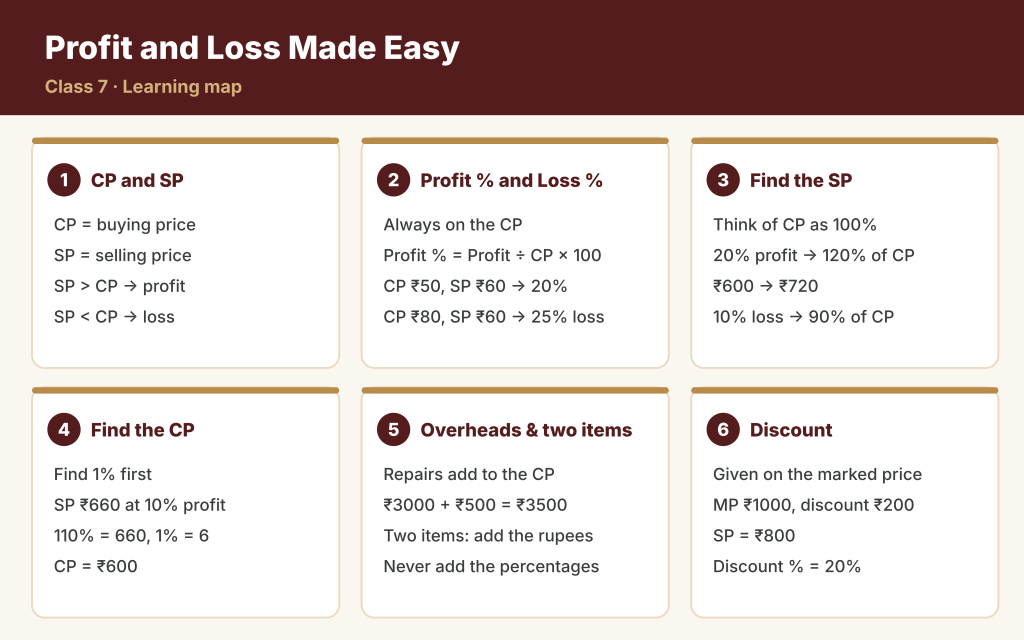
Let us understand it step by step.
What Is Cost Price?
Cost price is the price at which an item is bought. It is usually written as CP.
Example: If a shopkeeper buys a bag for ₹500, then Cost Price = ₹500. So, CP = ₹500.
What Is Selling Price?
Selling price is the price at which an item is sold. It is usually written as SP.
Example: If the shopkeeper sells the same bag for ₹650, then Selling Price = ₹650. So, SP = ₹650.
What Is Profit?
Profit happens when the selling price is more than the cost price. That means SP > CP.
Formula: Profit = SP − CP
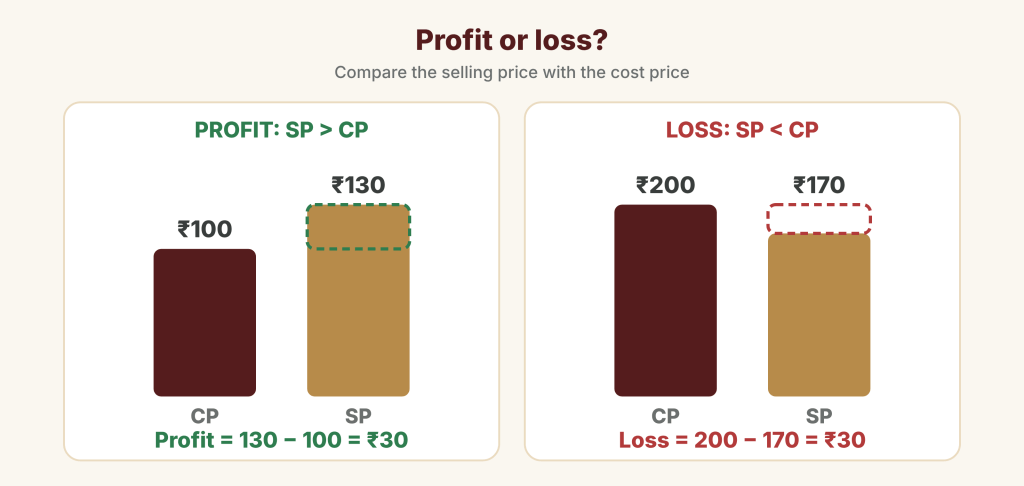
Example: A shopkeeper buys a book for ₹100 and sells it for ₹130.
CP = ₹100, SP = ₹130
Profit = SP − CP = 130 − 100 = ₹30
So, the shopkeeper makes a profit of ₹30.
What Is Loss?
Loss happens when the selling price is less than the cost price. That means SP < CP.
Formula: Loss = CP − SP
Example: A shopkeeper buys a toy for ₹200 and sells it for ₹170.
CP = ₹200, SP = ₹170
Loss = CP − SP = 200 − 170 = ₹30
So, the shopkeeper has a loss of ₹30.
Quick Way To Remember
- If SP > CP, there is a profit.
- If SP < CP, there is a loss.
- If SP = CP, there is no profit and no loss.
Profit Percentage
Profit percentage tells us the profit as a percentage of the cost price.
Why do we need it? A profit of ₹100 on a ₹400 bag is very good. A profit of ₹100 on a ₹40,000 laptop is very small. The percentage tells us how good the profit really is.
Formula: Profit% = Profit ÷ CP × 100
Example 1: Finding Profit Percentage
A pen is bought for ₹50 and sold for ₹60. Find the profit percentage.
CP = ₹50, SP = ₹60
First find profit: Profit = 60 − 50 = ₹10
Now find profit percentage:
Profit% = 10/50 × 100
Profit% = 20%
Loss Percentage
Loss percentage tells us the loss as a percentage of the cost price.
Formula: Loss% = Loss ÷ CP × 100
Example 2: Finding Loss Percentage
A toy is bought for ₹80 and sold for ₹60. Find the loss percentage.
CP = ₹80, SP = ₹60
First find loss: Loss = 80 − 60 = ₹20
Now find loss percentage:
Loss% = 20/80 × 100
Loss% = 25%
Remember: profit and loss percentages are always calculated on the cost price, never on the selling price.
Finding Selling Price When Profit Is Given
Sometimes, cost price and profit are given, and we need to find selling price.
Formula: SP = CP + Profit
Example: A bag is bought for ₹500. Profit is ₹100. Find the selling price.
SP = 500 + 100 = ₹600
Finding Selling Price When Loss Is Given
If there is a loss, selling price is less than cost price.
Formula: SP = CP − Loss
Example: A watch is bought for ₹1000. Loss is ₹150. Find the selling price.
SP = 1000 − 150 = ₹850
Finding Selling Price When Profit % or Loss % Is Given
Often, the profit or loss is given as a percentage. Then we first find the profit or loss in rupees.
Example 3: Selling Price When Profit % Is Given
A shopkeeper buys a watch for ₹600 and wants a profit of 20%. At what price should he sell it?
Profit = 20% of ₹600 = 20/100 × 600 = ₹120
SP = CP + Profit = 600 + 120 = ₹720
Example 4: Selling Price When Loss % Is Given
A mobile cover is bought for ₹1500 and sold at a loss of 10%. Find the selling price.
Loss = 10% of ₹1500 = 10/100 × 1500 = ₹150
SP = CP − Loss = 1500 − 150 = ₹1350
A quick shortcut: think of the CP as 100%
A 20% profit means the SP is 100% + 20% = 120% of the CP.
A 10% loss means the SP is 100% − 10% = 90% of the CP.
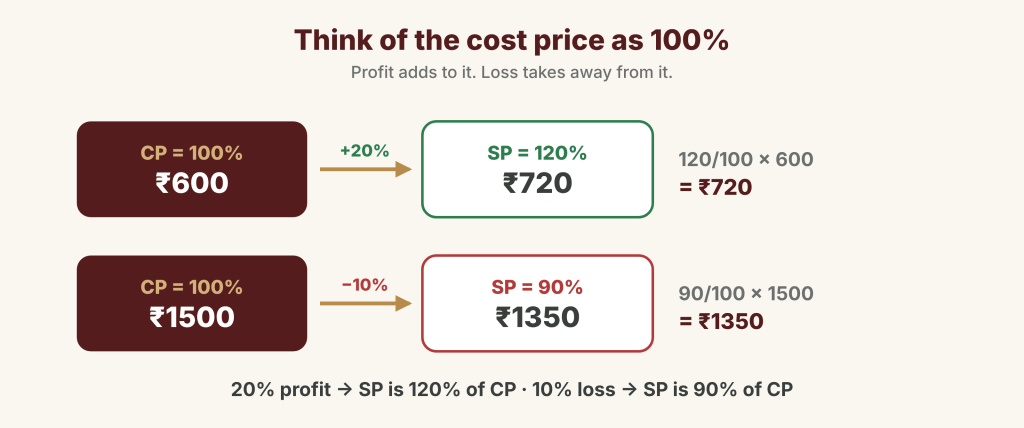
Check: 120% of ₹600 = 120/100 × 600 = ₹720, and 90% of ₹1500 = 90/100 × 1500 = ₹1350. Same answers, in one step.
Finding Cost Price
Sometimes, selling price and profit or loss are given, and we need to find cost price.
If there is profit: CP = SP − Profit
If there is loss: CP = SP + Loss
Example: An item is sold for ₹750 at a profit of ₹150. Find the cost price.
CP = SP − Profit = 750 − 150 = ₹600
Example 5: Cost Price When Profit % Is Given
A shirt is sold for ₹660 at a profit of 10%. Find the cost price.
The CP is 100%. With a 10% profit, the SP is 110% of the CP.
110% = ₹660
1% = 660 ÷ 110 = ₹6
100% = 6 × 100 = ₹600
Check: 10% of ₹600 = ₹60, and ₹600 + ₹60 = ₹660. ✓
Example 6: Cost Price When Loss % Is Given
A chair is sold for ₹855 at a loss of 5%. Find the cost price.
With a 5% loss, the SP is 95% of the CP.
95% = ₹855
1% = 855 ÷ 95 = ₹9
100% = 9 × 100 = ₹900
Overhead Expenses
Sometimes a seller spends extra money before selling an item, for example on repairs, transport or packing. These are called overhead expenses, and they are added to the cost price.
Total CP = Buying price + Overhead expenses
Example 7: Including Overhead Expenses
Ravi buys an old cycle for ₹3000. He spends ₹500 on repairs and sells it for ₹4200. Find his profit percentage.
Total CP = 3000 + 500 = ₹3500
Profit = 4200 − 3500 = ₹700
Profit% = 700/3500 × 100 = 20%
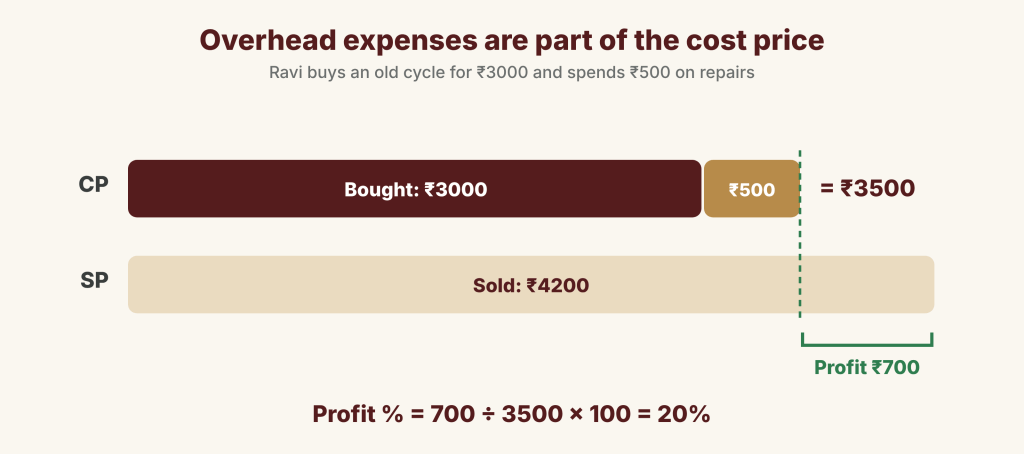
If Ravi forgot the repair cost, he would think his profit was ₹1200. That would be wrong.
Which Deal Is Better?
A bigger profit in rupees does not always mean a better deal. Compare the percentages.
Shop A buys a toy for ₹500 and sells it for ₹600. Profit = ₹100.
Shop B buys a toy for ₹1000 and sells it for ₹1150. Profit = ₹150.
Shop A: Profit% = 100/500 × 100 = 20%
Shop B: Profit% = 150/1000 × 100 = 15%
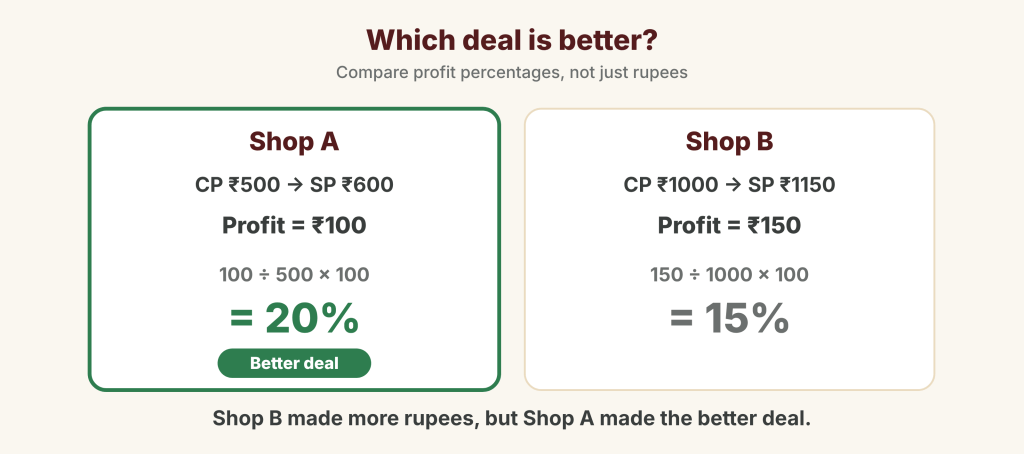
Shop B made more rupees, but Shop A made the better deal.
Profit or Loss on Two Items Together
When two items are sold, add all the cost prices and all the selling prices first.
Example: A shopkeeper buys two fans for ₹1200 each. He sells one at a profit of 10% and the other at a loss of 5%. Find his overall profit or loss.
Total CP = 1200 + 1200 = ₹2400
SP of first fan = 110% of ₹1200 = ₹1320
SP of second fan = 95% of ₹1200 = ₹1140
Total SP = 1320 + 1140 = ₹2460
Total SP is more than total CP, so there is a profit.
Profit = 2460 − 2400 = ₹60
Profit% = 60/2400 × 100 = 2.5%
Notice: the overall profit is not 10% − 5% = 5%. Always work with the actual rupees.
Profit and Loss in Real Life
Profit and loss are used in many real-life situations, such as buying and selling products, running a shop or business, and reselling books, toys, cycles or gadgets. Let us solve a few.
Example 1: Fruit Seller
A fruit seller buys 5 kg of mangoes at ₹60 per kg and sells them at ₹72 per kg.
CP = 5 × 60 = ₹300
SP = 5 × 72 = ₹360
Profit = 360 − 300 = ₹60
Profit% = 60/300 × 100 = 20%
Example 2: Selling an Old Phone
Meera bought a phone for ₹12,000. After two years, she sold it for ₹7,200.
Loss = 12000 − 7200 = ₹4800
Loss% = 4800/12000 × 100 = 40%
Example 3: School Fair Stall
Aman’s class spends ₹500 on lemons, sugar and cups, and ₹100 on decorating the stall. They sell 150 glasses of lemonade at ₹5 each.
Total CP = 500 + 100 = ₹600
Total SP = 150 × 5 = ₹750
Profit = 750 − 600 = ₹150
Profit% = 150/600 × 100 = 25%
Understanding profit and loss helps us make better money decisions.
What Is Discount?
Discount is a reduction in the marked price of an item.
For example, if a shirt has a marked price of ₹1000 and the shop gives a discount of ₹200, then the customer pays ₹1000 − ₹200 = ₹800.
So, discount reduces the price paid by the customer.
Marked Price and Selling Price
The price written on an item is called the marked price. The price after discount is called the selling price.
Formula: Selling Price = Marked Price − Discount
Example: A bag has a marked price of ₹1200. A discount of ₹300 is given. Find the selling price.
SP = 1200 − 300 = ₹900
Discount Percentage
Discount percentage is calculated on the marked price.
Formula: Discount% = Discount ÷ Marked Price × 100
Example: A shirt has a marked price of ₹1000. Discount is ₹200. Find the discount percentage.
Discount% = 200/1000 × 100 = 20%
When the discount is given as a percentage, find the discount in rupees first.
Example: A pair of shoes has a marked price of ₹800 with 25% off.
Discount = 25% of ₹800 = ₹200
SP = 800 − 200 = ₹600
Common Mistakes Students Make
Here are some common mistakes to avoid.
Mistake 1: Confusing Cost Price and Selling Price
Cost price is the buying price. Selling price is the selling price. Always identify CP and SP before solving.
Mistake 2: Calculating Profit or Loss Percentage on Selling Price
A bag bought for ₹400 is sold for ₹500. The profit is ₹100.
Wrong: Profit% = 100/500 × 100 = 20%
Correct: Profit% = 100/400 × 100 = 25%
Profit and loss percentages are always calculated on the cost price.
Mistake 3: Forgetting Overhead Expenses
Repairs, transport and packing are part of the cost price. Add them before working out the profit or loss.
Mistake 4: Confusing Discount With Loss
Discount is given on the marked price. Loss is based on the cost price and selling price. They are different ideas. A shop can give a discount and still make a profit.
Mistake 5: Adding or Subtracting Percentages of Two Items
A 10% profit on one item and a 5% loss on another does not give a 5% profit overall. Work out the total CP and total SP in rupees first.
Mistake 6: Using the Wrong Base When Finding the Cost Price
If a shirt is sold for ₹660 at 10% profit, the CP is not 660 − 10% of 660 = ₹594. The 10% is of the cost price, so the SP is 110% of the CP. That gives CP = ₹600.
Quick Practice
Try solving these questions.
- A book is bought for ₹100 and sold for ₹120. Find the profit.
- A toy is bought for ₹250 and sold for ₹200. Find the loss.
- A pen is bought for ₹40 and sold for ₹50. Find the profit percentage.
- A bag is bought for ₹500 and sold for ₹400. Find the loss percentage.
- An item is bought for ₹800. Profit is ₹200. Find the selling price.
- A watch is bought for ₹1500. Loss is ₹300. Find the selling price.
- An item is sold for ₹900 at a profit of ₹100. Find the cost price.
- A shirt has a marked price of ₹1000. Discount is ₹150. Find the selling price.
- A bag has a marked price of ₹2000. Discount is ₹400. Find the discount percentage.
- If CP = ₹600 and SP = ₹600, what is the profit or loss?
- A book is bought for ₹1200 and sold at a profit of 15%. Find the selling price.
- A toy is sold for ₹550 at a profit of 10%. Find the cost price.
- Raju buys an old scooter for ₹15,000, spends ₹1000 on repairs and sells it for ₹18,400. Find his profit percentage.
- A shopkeeper buys two bags for ₹800 each. He sells one at a 25% profit and the other at a 25% loss. Find his overall profit or loss.
Answers
Show answers
- ₹20
- ₹50
- 25%
- 20%
- ₹1000
- ₹1200
- ₹800
- ₹850
- 20%
- No profit and no loss
- ₹1380 (15% of 1200 = 180)
- ₹500 (110% = 550, so 1% = 5)
- 15% (CP = ₹16,000, profit = ₹2400)
- No profit, no loss (total CP = ₹1600, total SP = ₹1000 + ₹600 = ₹1600)
Final Thoughts
Profit and loss help us understand buying and selling.
Remember:
- Profit = SP − CP, and Loss = CP − SP
- Profit% = Profit ÷ CP × 100, and Loss% = Loss ÷ CP × 100
- Profit and loss percentages are always on the cost price
- Overhead expenses are added to the cost price
- To find the SP or CP from a percentage, think of the CP as 100%
- For two or more items, work with total rupees, not percentages
- Discount is calculated on the marked price
Start by identifying cost price and selling price. Once you know these two values, profit and loss problems become much easier.
With regular practice, profit and loss will become a very useful and simple topic.
Happy learning,
Mathsbaron


Leave a Reply