
Hi everyone,
Welcome to another Mathsbaron lesson.
In the previous lesson, we learned about fractions and decimals. We understood what they mean, how they are connected, and how to add and subtract them.
In this lesson, we will take the next step. We will learn how to multiply and divide fractions and decimals.
These topics are very important because they are used in many real-life situations such as money, measurement, recipes, distance, speed, time and percentage.
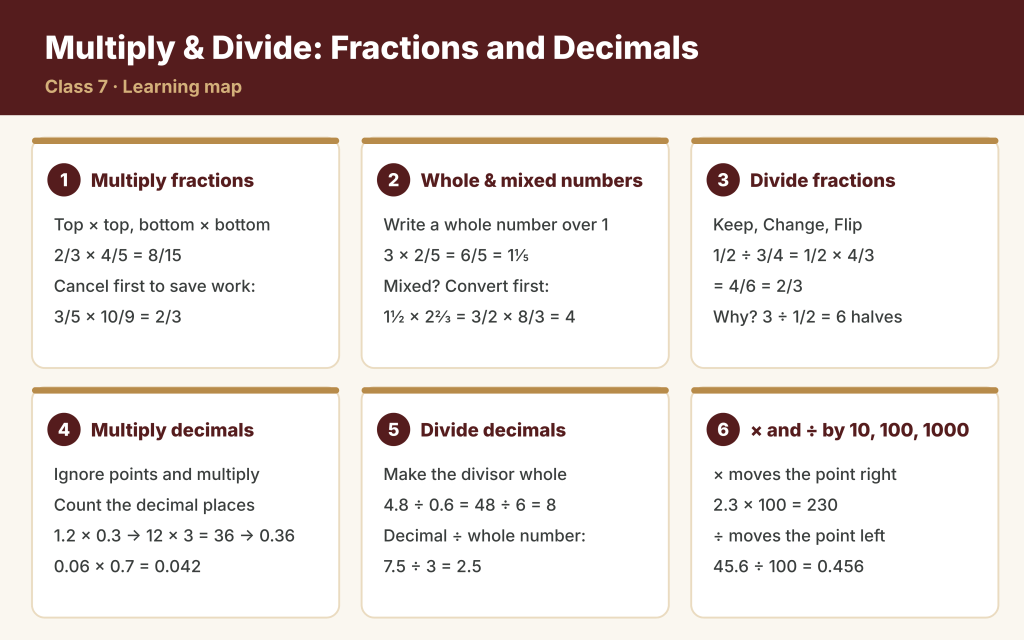
Let us understand them step by step.
Quick Recap: What Are Fractions?
A fraction represents a part of a whole. For example, in 3/4:
- 3 is the numerator
- 4 is the denominator
The denominator tells us how many equal parts the whole is divided into. The numerator tells us how many parts we are taking. So 3/4 means 3 parts out of 4 equal parts.
Quick Recap: What Are Decimals?
Decimals are another way of writing parts of a whole, such as 0.5, 0.25 and 1.75. We know:
0.5 = 1/2
0.25 = 1/4
0.75 = 3/4
So, fractions and decimals are closely connected.
Multiplying Fractions
Multiplying fractions is simple. To multiply two fractions:
- Multiply the numerators
- Multiply the denominators
- Simplify the answer if possible
Example: 2/3 × 4/5
Multiply the numerators: 2 × 4 = 8
Multiply the denominators: 3 × 5 = 15
So, 2/3 × 4/5 = 8/15
Example 1: Multiplying Fractions
Let us multiply 1/2 × 3/4.
Step 1: Multiply the numerators: 1 × 3 = 3
Step 2: Multiply the denominators: 2 × 4 = 8
So, 1/2 × 3/4 = 3/8
Here is what this means. 1/2 × 3/4 is the same as half of 3/4:
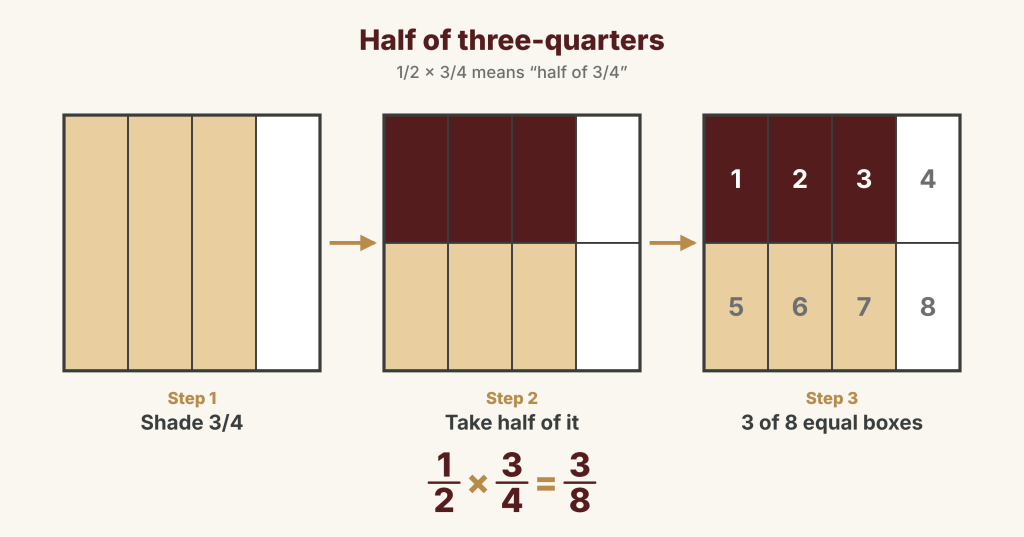
Notice that the answer, 3/8, is smaller than 3/4. When we multiply by a fraction less than 1, we are taking a part of something, so the answer gets smaller.
Example 2: Multiplying Fractions
Let us multiply 3/5 × 10/9.
Step 1: Multiply the numerators: 3 × 10 = 30
Step 2: Multiply the denominators: 5 × 9 = 45
So, 3/5 × 10/9 = 30/45
Now simplify: 30/45 = 2/3. So, 3/5 × 10/9 = 2/3
A Useful Tip: Simplify Before Multiplying
Sometimes, we can simplify before multiplying. Take the same example, 3/5 × 10/9.
Cancel 10 and 5: 10 ÷ 5 = 2, so we get 3/1 × 2/9
Now cancel 3 and 9: 9 ÷ 3 = 3, so we get 1/1 × 2/3
So, 3/5 × 10/9 = 2/3
This gives the same answer, but with less calculation.
Multiplying a Fraction by a Whole Number
To multiply a fraction by a whole number, write the whole number as a fraction with denominator 1.
Example: 3 × 2/5
Write 3 as 3/1, so we get 3/1 × 2/5
Multiply: 3 × 2 = 6 and 1 × 5 = 5
So, 3 × 2/5 = 6/5, which can also be written as 1⅕.
Multiplying Mixed Fractions
A mixed fraction has a whole number and a fraction together, such as 1½. Before multiplying, always change mixed fractions into improper fractions.
Example: 1½ × 2⅔
1½ = 3/2 and 2⅔ = 8/3
3/2 × 8/3 = 24/6 = 4
Do not multiply the whole numbers and the fractions separately. That gives the wrong answer.
Dividing Fractions
Division of fractions becomes easy when we use the reciprocal. The reciprocal of a fraction is found by flipping the numerator and denominator.
The reciprocal of 2/3 is 3/2.
The reciprocal of 5/7 is 7/5.
Rule for Dividing Fractions
To divide fractions:
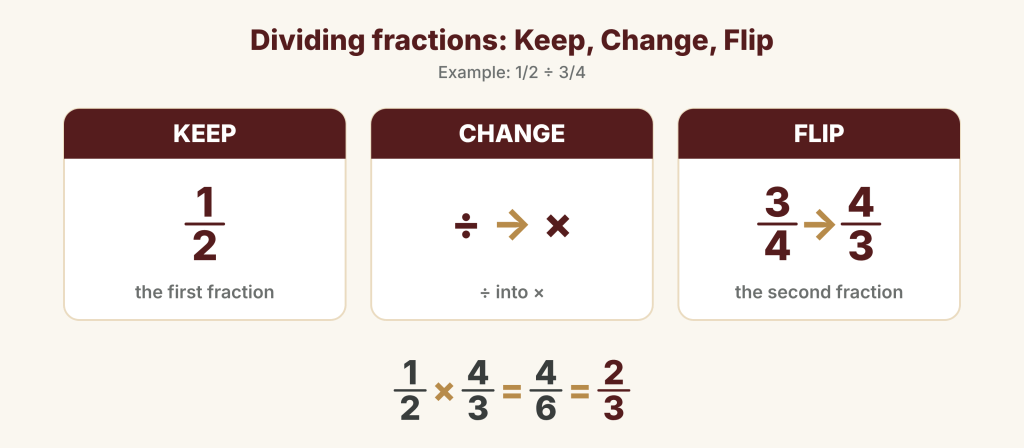
- Keep the first fraction the same
- Change division into multiplication
- Flip the second fraction
- Multiply
This is often remembered as Keep, Change, Flip.
Why Does Flipping Work?
Let us ask a simple question: how many halves are there in 3?
Each whole has 2 halves, so 3 wholes have 6 halves. That means 3 ÷ 1/2 = 6.
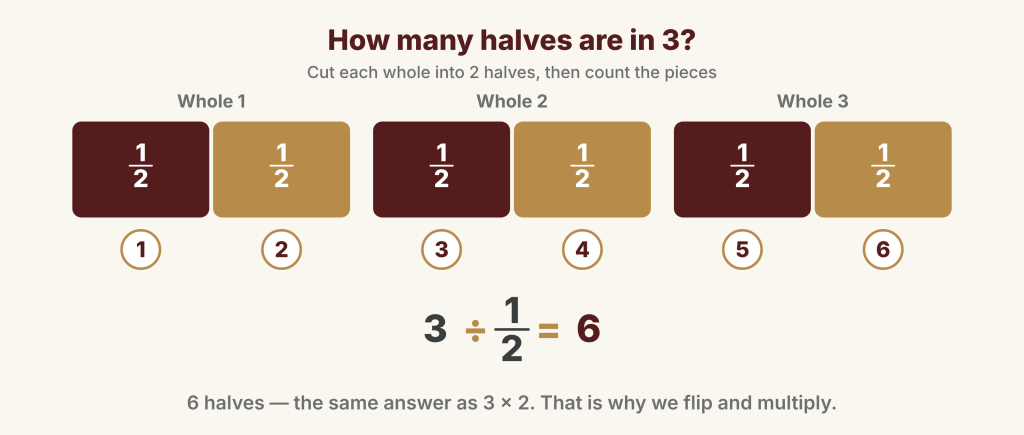
Now look at Keep, Change, Flip: 3 ÷ 1/2 = 3 × 2/1 = 6. Dividing by 1/2 gives the same answer as multiplying by 2. That is why we flip the second fraction and multiply.
Example 1: Dividing Fractions
Let us divide 1/2 ÷ 3/4.
Step 1: Keep the first fraction: 1/2
Step 2: Change division into multiplication: 1/2 ×
Step 3: Flip the second fraction: 3/4 becomes 4/3
So, 1/2 ÷ 3/4 = 1/2 × 4/3
Multiply: 1 × 4 = 4 and 2 × 3 = 6, so we get 4/6
Simplify: 4/6 = 2/3. So, 1/2 ÷ 3/4 = 2/3
Example 2: Dividing Fractions
Let us divide 5/6 ÷ 2/3.
Keep, Change, Flip: 5/6 × 3/2
Multiply: 5 × 3 = 15 and 6 × 2 = 12, so we get 15/12
Simplify: 15/12 = 5/4. So, 5/6 ÷ 2/3 = 5/4, which can also be written as 1¼.
Multiplying Decimals
When multiplying decimals, follow these steps:
- Multiply the numbers as if there is no decimal point
- Count the total number of digits after the decimal points
- Put the decimal point in the answer
Example 1: Multiplying Decimals
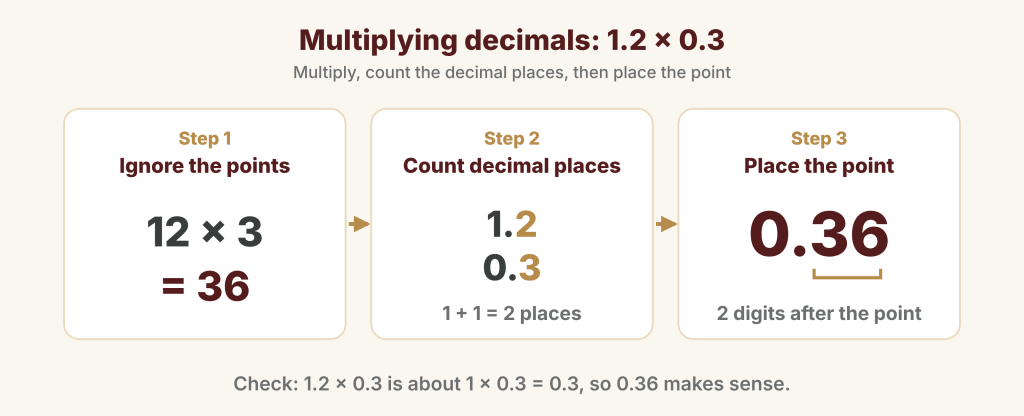
Let us multiply 1.2 × 0.3.
First multiply without decimals: 12 × 3 = 36
Now count decimal places: 1.2 has 1 digit after the decimal point, and 0.3 has 1 digit after the decimal point.
Total decimal places: 1 + 1 = 2
So, the answer must have 2 digits after the decimal point. Therefore, 1.2 × 0.3 = 0.36
Example 2: Multiplying Decimals
Let us multiply 2.5 × 1.4.
First multiply without decimals: 25 × 14 = 350
Now count decimal places: 2.5 has 1 and 1.4 has 1, so 1 + 1 = 2
So, 2.5 × 1.4 = 3.50, which means 2.5 × 1.4 = 3.5
Multiplying Decimals by 10, 100 and 1000
When multiplying decimals by 10, 100 or 1000, the decimal point moves to the right.
2.3 × 10 = 23
2.3 × 100 = 230
2.3 × 1000 = 2300
Another example:
0.45 × 10 = 4.5
0.45 × 100 = 45
Dividing Decimals
Dividing a Decimal by a Whole Number
This is the easiest case. Divide as usual, and keep the decimal point in the same place.
7.5 ÷ 3 = 2.5
0.84 ÷ 4 = 0.21
Dividing by a Decimal
When dividing by a decimal, the main goal is to make the divisor a whole number. The divisor is the number we are dividing by.
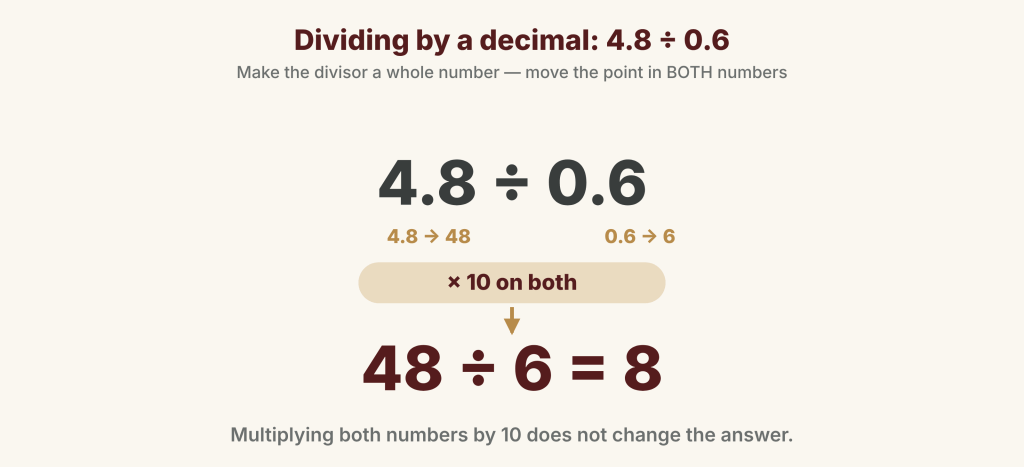
Example: 4.8 ÷ 0.6. Here, 0.6 is the divisor.
To make 0.6 a whole number, multiply both numbers by 10:
4.8 × 10 = 48 and 0.6 × 10 = 6
So, 4.8 ÷ 0.6 = 48 ÷ 6 = 8. Therefore, 4.8 ÷ 0.6 = 8
Example 2: Dividing Decimals
Let us divide 3.75 ÷ 0.5.
Make the divisor a whole number: 0.5 × 10 = 5, so multiply both numbers by 10.
3.75 × 10 = 37.5 and 0.5 × 10 = 5
Now divide: 37.5 ÷ 5 = 7.5. So, 3.75 ÷ 0.5 = 7.5
Dividing Decimals by 10, 100 and 1000
When dividing decimals by 10, 100 or 1000, the decimal point moves to the left.
45.6 ÷ 10 = 4.56
45.6 ÷ 100 = 0.456
45.6 ÷ 1000 = 0.0456
Fractions and Decimals in Real Life
Multiplication and division of fractions and decimals are used in everyday life:
- Half of 3/4 litre of juice
- 2.5 kg of rice costing a certain amount per kg
- Dividing 1.5 litres of milk among 3 people
- Calculating distance, money and measurements
- Finding parts of a recipe
- Working with discounts and percentages
Let us solve a few of these.
Juice: What is half of 3/4 litre of juice?
1/2 × 3/4 = 3/8 litre
Rice: Rice costs ₹48.60 per kg. How much do 2.5 kg cost?
2.5 × 48.60 = ₹121.50
Milk: 1.5 litres of milk is shared equally among 3 people. How much does each person get?
1.5 ÷ 3 = 0.5 litre each
Ribbon: A 6 m ribbon is cut into pieces that are 3/4 m long. How many pieces are there?
6 ÷ 3/4 = 6 × 4/3 = 24/3 = 8 pieces
Common Mistakes Students Make
Here are some common mistakes to avoid.
Mistake 1: Adding Denominators While Multiplying Fractions
Wrong: 1/2 × 1/3 = 1/5
Correct: 1/2 × 1/3 = 1/6
When multiplying fractions, multiply the denominators. Do not add them.
Mistake 2: Forgetting To Flip the Second Fraction
Wrong: 1/2 ÷ 3/4 = 1/2 × 3/4
Correct: 1/2 ÷ 3/4 = 1/2 × 4/3
When dividing fractions, flip the second fraction.
Mistake 3: Placing the Decimal Point Incorrectly
In decimal multiplication, always count the total number of decimal places. For example, 1.2 × 0.3 = 0.36, not 3.6.
Mistake 4: Losing a Zero
Wrong: 0.06 × 0.7 = 0.42
Correct: 0.06 × 0.7 = 0.042
6 × 7 = 42, and there are 2 + 1 = 3 decimal places. Since 42 has only 2 digits, add a zero in front to make 3 decimal places: 0.042.
Mistake 5: Moving the Decimal Point in the Wrong Direction
When multiplying by 10, 100 or 1000, move the decimal point to the right. When dividing by 10, 100 or 1000, move the decimal point to the left.
Quick Practice
Try solving these questions.
- 2/3 × 3/4
- 5/6 × 2/5
- 3 × 4/7
- 1/2 ÷ 3/4
- 4/5 ÷ 2/3
- 1.5 × 0.4
- 2.5 × 1.2
- 4.8 ÷ 0.6
- 7.5 ÷ 0.5
- 36.4 ÷ 10
- A bottle holds 1.5 litres of juice. How many 0.25-litre glasses can it fill?
- A rope 4½ m long is cut into pieces 3/4 m long. How many pieces are there?
Answers
Show answers
- 1/2
- 1/3
- 12/7 = 1 5/7
- 2/3
- 6/5 = 1⅕
- 0.6
- 3
- 8
- 15
- 3.64
- 6 glasses (1.5 ÷ 0.25 = 150 ÷ 25)
- 6 pieces (9/2 ÷ 3/4 = 9/2 × 4/3 = 36/6)
Final Thoughts
Multiplying and dividing fractions and decimals becomes easy when we understand the rules.
For fractions:
- Multiply numerator with numerator
- Multiply denominator with denominator
- Change mixed fractions into improper fractions first
- For division, use Keep, Change, Flip
For decimals:
- Count decimal places while multiplying
- Make the divisor a whole number while dividing
- Move the decimal point carefully when using 10, 100 or 1000
Start slowly. Practise small examples first. Once the rules become familiar, these calculations will feel much easier.
Next lesson: Ready for more? See how fractions and decimals turn into marks, discounts and profit in Percentage Made Easy for Class 7.
Happy learning,
Mathsbaron


Leave a Reply