
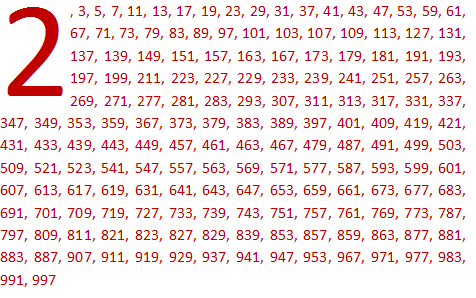
 A prime number is a natural number greater than 1 that has no positive divisors other than 1 and itself. The numbers in the picture are the first 168 prime numbers, all of which are less than 1000.
The study of prime numbers dates back to the ancient Greeks around 300 BC. Little further progress was made until the 17th century, when Pierre de Fermat came up with Fermat numbers. Marin Mersenne, a French philosopher and mathematician, studied primes of the form 2p – 1, now known as Mersenne primes.
Way back in the 3rd century BC, the Greek mathematician Euclid proved that there are infinitely many prime numbers. Since then mathematicians have been on an endeavour to find ever larger primes. In January 2013, Dr. Curtis Cooper of the University of Central Missouri discovered the Mersenne prime 257,885,161 – 1 (a 17,425,170-digit number), the largest known prime at the time. The number is so big that the primality proof took 39 days of non-stop computing on one of the university’s computers.
The record has been broken several times since. Today the largest known prime is the Mersenne prime 2136,279,841 – 1, a 41,024,320-digit number found in October 2024 through the Great Internet Mersenne Prime Search.
For a long time prime numbers had little practical use. That changed with modern computing: much of today’s cryptography, which keeps online banking and messaging secure, is built on prime numbers.


Leave a Reply