
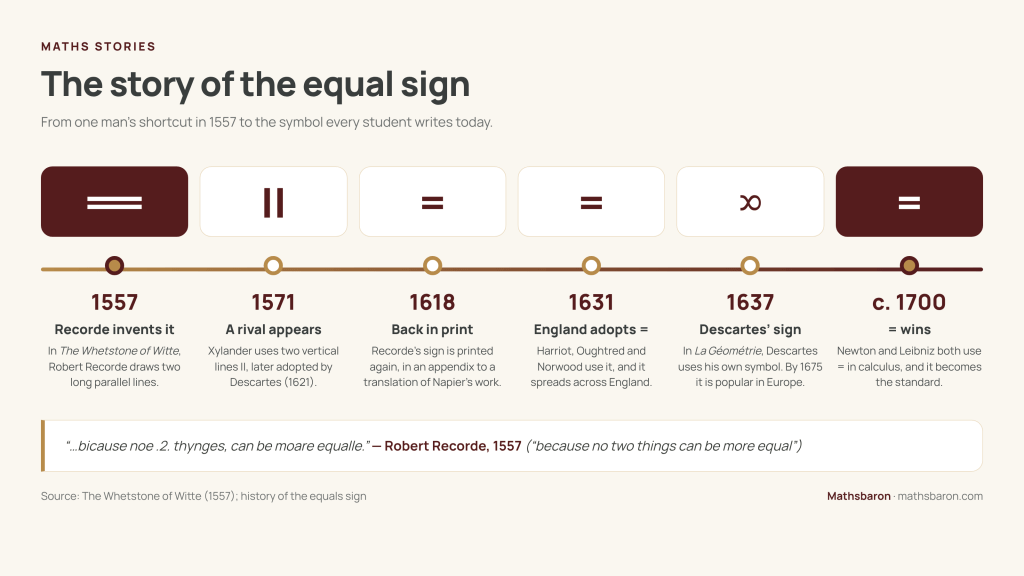
You probably write the equal sign dozens of times a day. But = has not always existed — someone had to invent it, and it took about 150 years for the rest of the world to agree.
Robert Recorde’s shortcut (1557)
The equal sign was introduced by the Welsh mathematician and physician Robert Recorde in 1557, in his algebra book The Whetstone of Witte. Tired of writing the words “is equal to” again and again, he drew two parallel lines instead — much longer than the sign we use today.
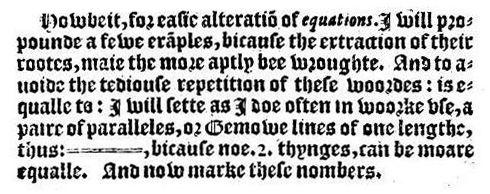
Here is how he explained it, in the English of his time:
“To avoide the tediouse repetition of these woordes : is equalle to : I will sette as I doe often in woorke use, a paire of paralleles, or Gemowe lines of one lengthe, thus: =====, bicause noe .2. thynges, can be moare equalle.”
Robert Recorde, The Whetstone of Witte, 1557
In modern English: “To avoid the tedious repetition of the words ‘is equal to’, I will use a pair of parallel, or twin, lines of the same length, because no two things can be more equal.” (“Gemowe” is an old word meaning twin.)
Below is the page from his book where the equal sign appears for the first time.
The same book also introduced the plus (+) and minus (−) signs to English readers.
The battle of the symbols
Recorde’s idea did not catch on straight away. For over a century, mathematicians used different symbols for “equals”:
- 1571: Wilhelm Xylander used two vertical lines, ||. Several writers followed, including René Descartes in 1621.
- 1618: Recorde’s = finally appeared in print again, in an appendix to an English translation of John Napier’s work on logarithms.
- 1631: Thomas Harriot, William Oughtred and Richard Norwood used =, and it spread across England.
- 1637: Descartes introduced a symbol of his own in La Géométrie. By about 1675 it was popular across Europe.
- Around 1700: = won. Both Isaac Newton and Gottfried Leibniz used it in their work on calculus, and the rest of Europe followed.
Why the equal sign matters in class
The = sign means “has the same value as”. Think of it as a balance: whatever is on the left must weigh exactly the same as whatever is on the right.
Many students use = to mean “and the answer is”. That leads to chains like this:
3 + 4 = 7 + 2 = 9 ✗ (3 + 4 is not equal to 9)
Each step should be a true statement on its own:
3 + 4 = 7
7 + 2 = 9              ✔
Seeing = as a balance also makes algebra easier: in x + 5 = 12, you can take 5 from both sides and the balance still holds, so x = 7.
Who invented the other symbols?
| Symbol | Meaning | First used by | Year |
|---|---|---|---|
| + − | plus, minus | Johannes Widmann (first in print) | 1489 |
| √ | square root | Christoff Rudolff | 1525 |
| = | equals | Robert Recorde | 1557 |
| × | multiply | William Oughtred | 1631 |
| < > | less than, greater than | Thomas Harriot | 1631 |
| ÷ | divide | Johann Rahn | 1659 |
Quick quiz
- In which year was the equal sign first used, and in which book?
- Why did Recorde choose two parallel lines?
- What is wrong with writing
5 × 2 = 10 − 3 = 7?
Show answers
- 1557, in Robert Recorde’s The Whetstone of Witte.
- Because “no two things can be more equal” than two parallel lines of the same length.
- It claims 5 × 2 = 7, which is false. Write it as two true statements: 5 × 2 = 10, then 10 − 3 = 7.
Enjoyed this story? Read about Ramanujan’s number, celebrate Pi Day, or discover the largest known prime number.
Happy learning,
Mathsbaron


Leave a Reply