
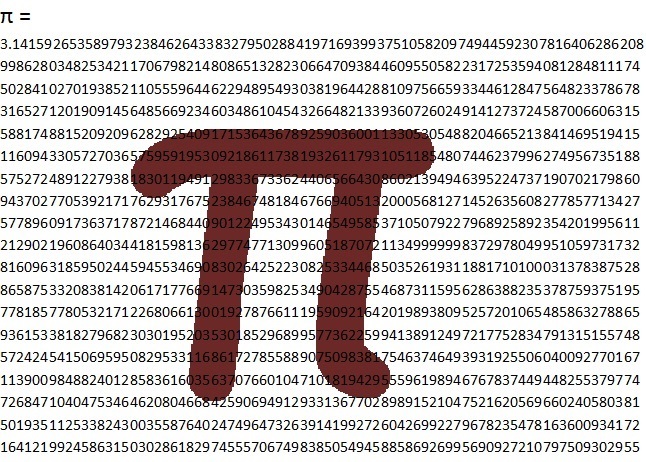
 March 14 (03/14) is celebrated as Pi (π) day by mathematician scholars and enthusiasts around the world because 3, 1 and 4 are the first three significant digits in the value of Pi.
The number Pi is defined as ratio of circumference of circle to its diameter and is a constant number. In other words you measure the circumference of the circle and divide it by its diameter to get the value of Pi and this holds true for circles of any radius or diameter.
For centuries the number π aka Pi has been the center of attention and fascination for mathematicians and scholars. The ancient Greek mathematician and scientist Archimedes (c. 287 – 212 BC) is credited with the first rigorous approximation of Pi. He used 96-sided polygons to show that the value of Pi lies between 310⁄71 (approximately 3.1408) and 31⁄7 (approximately 3.1429), consistent with its actual value of approximately 3.1416. Archimedes also proved that the area of a circle is Pi multiplied by the square of its radius (A = πr²). The famous symbol π came much later: the Welsh mathematician William Jones first used it in 1706, and Leonhard Euler made it popular.


Leave a Reply