
Vedic Mathematics is a system of mental calculation popularised by Sri Bharati Krishna Tirthaji Maharaj in his 1965 book Vedic Mathematics. It is built on sixteen short formulas called sutras, which help students solve calculations in a faster, simpler and more interesting way.
The word sutra means a short rule or formula. Tirthaji said the sutras came from an appendix of the Atharvaveda; scholars have not found them there, so it is best to see them as his own brilliant system. What matters for students is that every method is mathematically sound — and genuinely useful.
Vedic Maths helps students:
- calculate faster and improve mental maths
- understand number patterns
- reduce fear of long calculations
- build confidence in mathematics
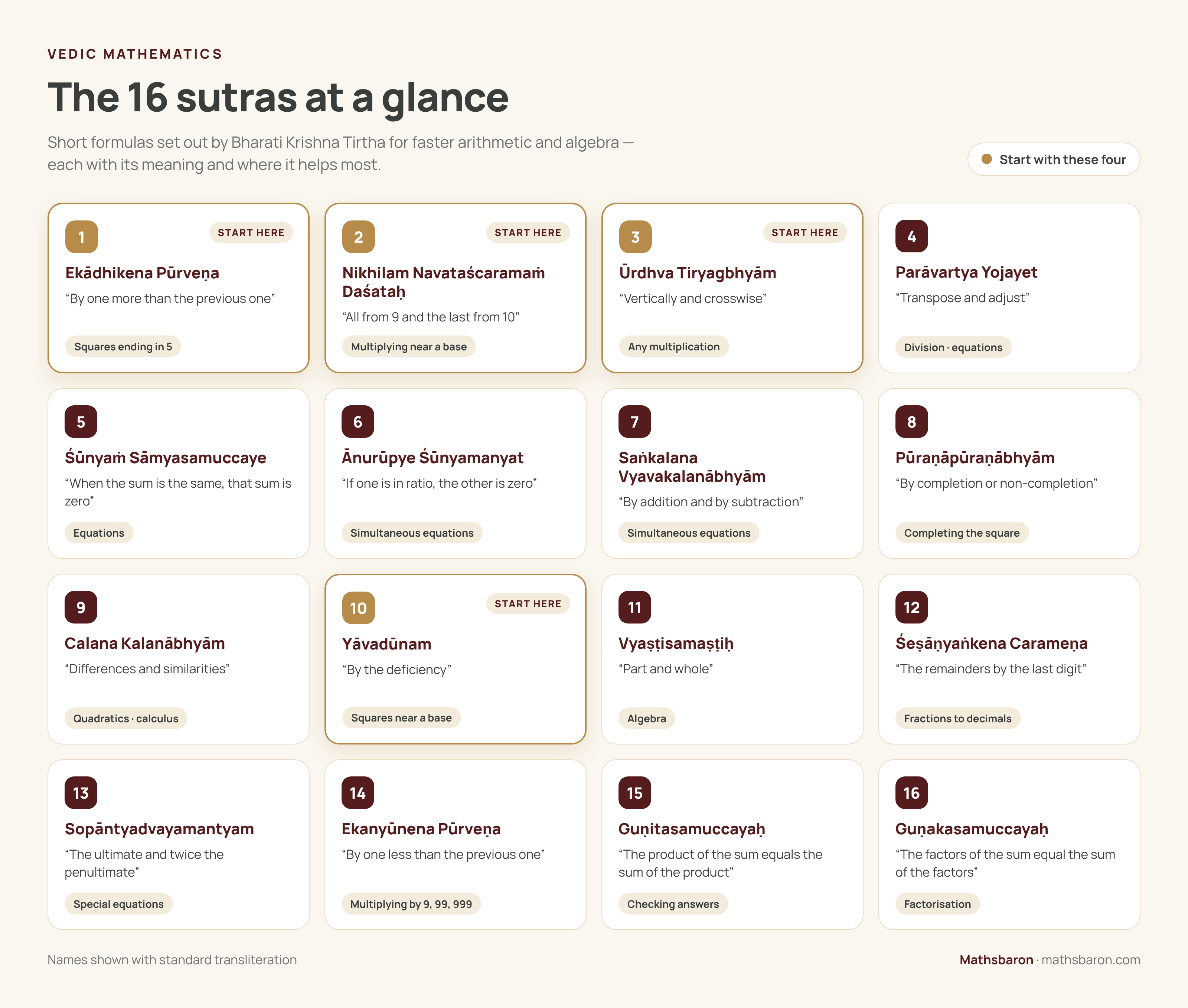
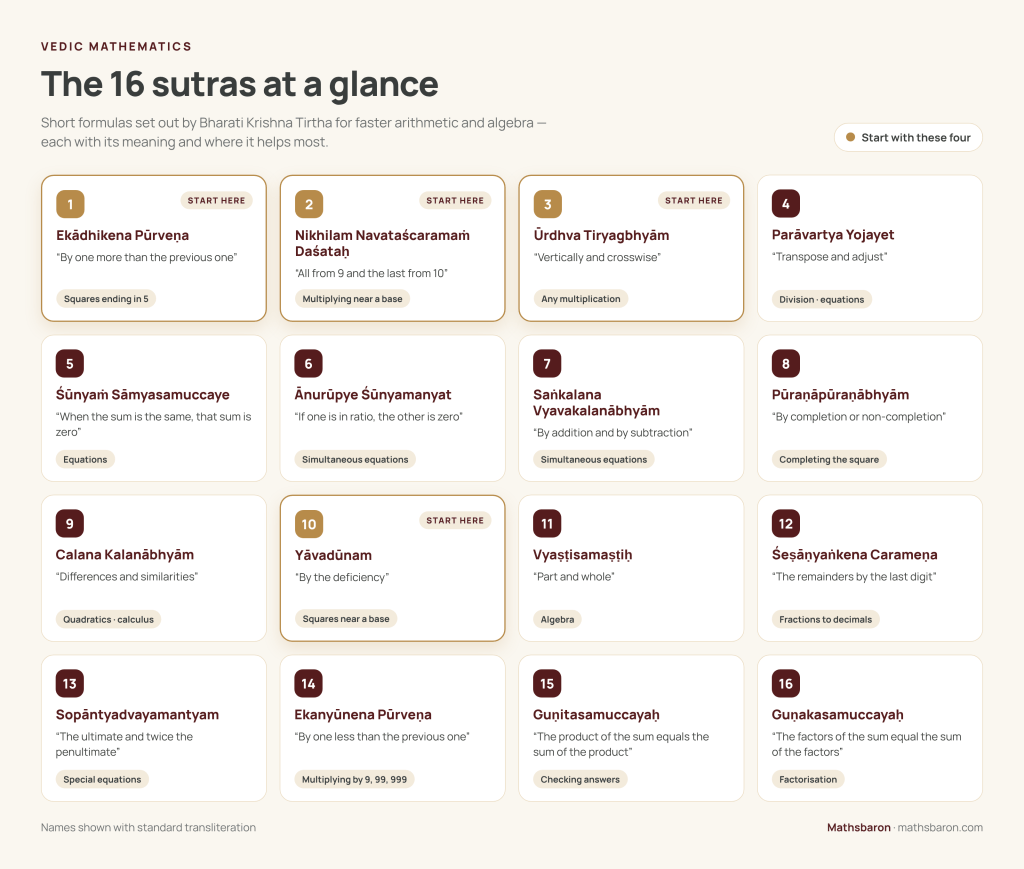
Below, each sutra has its meaning, what it is used for, and a quick example where one helps. The four marked Start here are the best first steps.
The 16 sutras
1. Ekadhikena Purvena — Start here
Meaning: By one more than the previous one.
Best known for squaring numbers that end in 5, and also used for recurring decimals such as 1/19. Example: 35² → multiply 3 by one more than itself (3 × 4 = 12), then write 25: 1225. Read the full lesson →
2. Nikhilam Navatashcaramam Dashatah — Start here
Meaning: All from 9 and the last from 10.
One of the most popular sutras — ideal for multiplying numbers close to 10, 100 or 1000. Example: 98 × 97: the numbers are 2 and 3 below 100, so 98 − 3 = 95 and 2 × 3 = 06, giving 9506. Read the full lesson →
3. Urdhva Tiryagbhyam — Start here
Meaning: Vertically and crosswise.
A general method for multiplying any numbers — two-digit, three-digit and beyond — writing the answer in a single line. Example: 12 × 34 = 408. Read the full lesson → or try the 789 × 263 worked example.
4. Paravartya Yojayet
Meaning: Transpose and adjust.
Used for division when the divisor is slightly more than a power of 10 (such as 12 or 112), and for solving simple equations by moving terms across and adjusting.
5. Shunyam Saamyasamuccaye
Meaning: When the sum is the same, that sum is zero.
Used to spot equations whose answer is immediately zero. Example: in (x + 7)(x + 9) = (x + 3)(x + 21), the constant terms match (7 × 9 = 3 × 21 = 63), so x = 0.
6. Anurupye Shunyamanyat
Meaning: If one is in ratio, the other is zero.
Used for simultaneous equations with a special ratio. Example: 3x + 7y = 2 and 4x + 21y = 6 — the y-coefficients (7 : 21) are in the same ratio as the right-hand sides (2 : 6), so x = 0 and y = 2/7.
7. Sankalana Vyavakalanabhyam
Meaning: By addition and by subtraction.
Used for simultaneous equations where the x and y coefficients are swapped. Example: 45x − 23y = 113 and 23x − 45y = 91. Adding gives x − y = 3; subtracting gives x + y = 1; so x = 2, y = −1.
8. Puranapuranabhyam
Meaning: By completion or non-completion.
The idea behind completing the square (or cube) — making an expression “complete” so that it becomes easy to solve. Students meet it when solving quadratic equations.
9. Chalana Kalanabhyam
Meaning: Differences and similarities.
Used in Tirthaji’s methods for quadratic equations and early calculus, by looking at how an expression changes (its differences). It is best explored after Class 10 algebra.
10. Yavadunam — Start here
Meaning: By the deficiency.
Used for squaring numbers close to a base such as 10, 100 or 1000. Example: 96² — 96 is 4 below 100, so 96 − 4 = 92 and 4² = 16, giving 9216. Read the full lesson →
11. Vyashtisamashtih
Meaning: Part and whole.
Looks at how the parts of an expression relate to the whole — used in Tirthaji’s methods for factorisation and some special equations.
12. Shesanyankena Charamena
Meaning: The remainders by the last digit.
Used to turn fractions such as 1/7 or 1/13 into recurring decimals quickly, by working with remainders.
13. Sopaantyadvayamantyam
Meaning: The ultimate and twice the penultimate.
Used to solve a special family of algebraic equations involving fractions. It looks complex at first, but becomes clear through examples.
14. Ekanyunena Purvena
Meaning: By one less than the previous one.
The partner of Sutra 1 — used for multiplying by 9, 99, 999 and so on. Example: 43 × 99 → one less than 43 is 42, and 99 − 42 = 57, giving 4257.
15. Gunitasamuccayah
Meaning: The product of the sum equals the sum of the product — that is, multiply the sums of the coefficients in each factor, and you get the sum of the coefficients in the answer.
A quick way to check algebra. Example: is (x + 2)(x + 3) = x² + 5x + 6? The factor sums are 3 and 4, and 3 × 4 = 12; the answer’s coefficients add to 1 + 5 + 6 = 12. ✔
16. Gunakasamuccayah
Meaning: The factors of the sum are equal to the sum of the factors.
Used in factorisation, especially of cubic and higher expressions, and for checking that factors are correct.
Why learn Vedic Mathematics?
Vedic Maths is not just a set of tricks — it is a way of seeing numbers differently. When students learn the sutras with examples, they start noticing patterns and understand that mathematics is about finding smarter ways to solve problems, not only memorising steps.
It is especially helpful for school maths, mental maths practice, competitive exams and Olympiads, multiplication and division, squares and roots, and algebraic thinking.
How should students start?
Do not try to memorise all 16 sutras at once. Start with the four that give the quickest wins, and practise each through examples:
- Ekadhikena Purvena — squares of numbers ending in 5
- Nikhilam — multiplying numbers close to 10, 100 or 1000
- Urdhva Tiryagbhyam — any multiplication
- Yavadunam — squares of numbers close to a base
Once these feel natural, students in higher classes can explore the algebra sutras (5, 6, 7 and 15) step by step.
Final thoughts
The 16 sutras offer a powerful way to understand numbers, calculations and patterns. For students, the goal is not just to calculate faster, but to build confidence and curiosity in mathematics. New to the subject? Read Vedic Mathematics – an overview, and look out for more Mathsbaron lessons with examples and practice questions.
Happy learning,
Mathsbaron


Leave a Reply